More
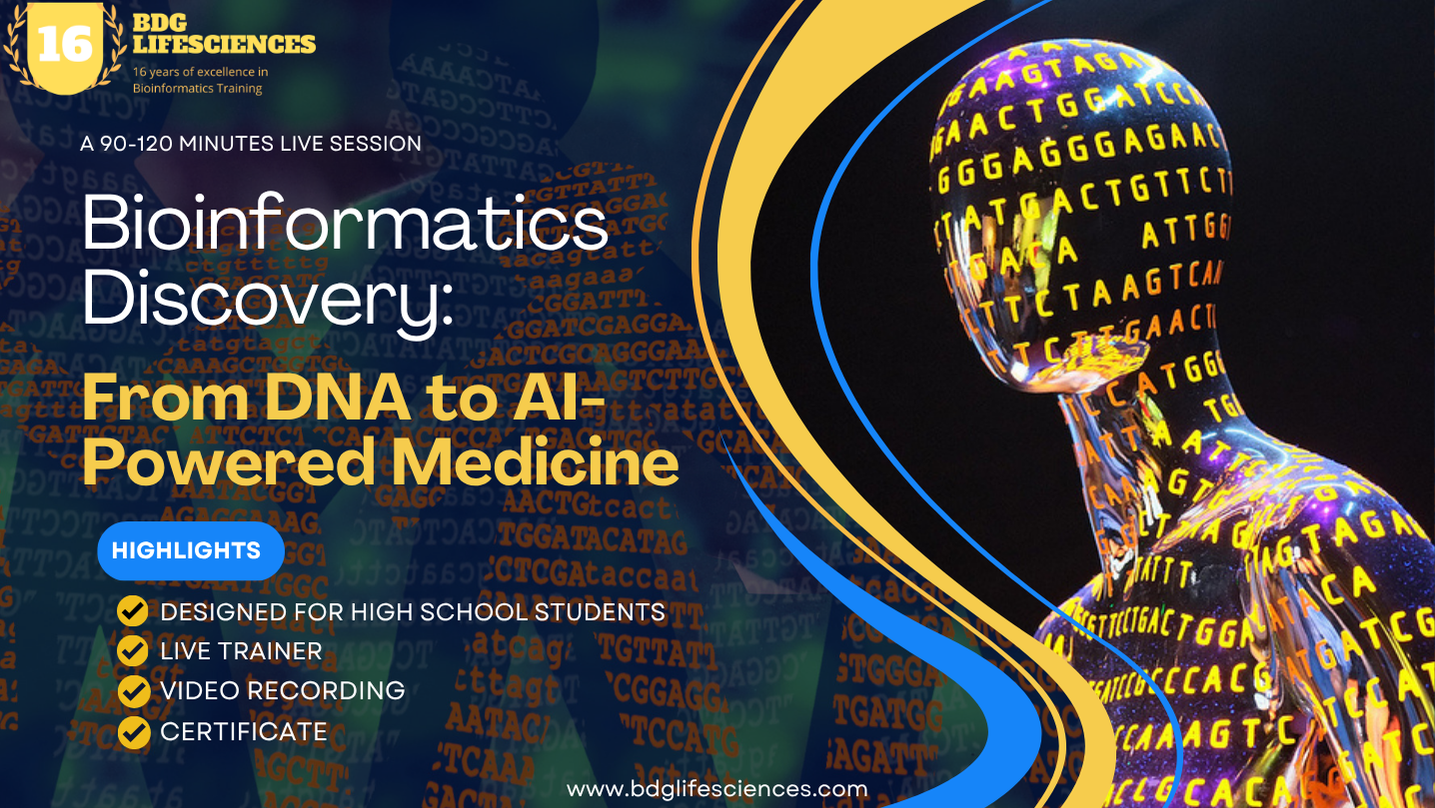
Bioinformatics Discovery: From DNA to AI-Powered Medicine
Bioinformatics for High School Students: Discover the Science Behind DNA, Proteins and AI
4.7
This Event Includes
- High demand video
- Learn from Experts
- Hands-on practical sessions
- Certificate on completion
Registration Fee |
|
In US $ |
19 |
Biology · Computing · Data · AI — an introductory science experience for high school students, by BDG Lifesciences.
90–120Minute live session |
Grades 8–12High school students |
7Guided parts |
NoPrior experience needed |
Bioinformatics Discovery: From DNA to AI-Powered Medicine
Bioinformatics Discovery: From DNA to AI-Powered Medicine is an introductory science experience designed to help high school students discover how biology, computer science, and data analysis come together to answer important questions about life.
| Question 1 How do scientists compare DNA sequences? |
Question 2 How can a computer help researchers explore the structure of a protein? |
Question 3 What role does biological data play in understanding diseases and developing potential medicines? |
||
These are the kinds of questions that bioinformatics helps investigate.
In this proposed 90–120-minute introductory session, students will explore the principles behind modern computational biology through accessible scientific explanations, selected demonstrations of real research resources, and an opportunity to apply their understanding to a guided challenge.
Developed around subjects taught in BDG Lifesciences’ broader bioinformatics training programmes, this session offers a first look at how biological information is explored and interpreted using computational tools.
No previous bioinformatics or programming experience is required. The aim is to spark curiosity, make an unfamiliar scientific field approachable, and help students discover whether they would like to explore it further.
What Is Bioinformatics?
Bioinformatics combines biology with computational methods to help scientists organise, examine, compare, and interpret biological information.
Living organisms contain complex biological information, including DNA sequences, genes, and proteins. Researchers use databases, algorithms, visualisation tools, and computational models to investigate this information and develop a better understanding of biological processes.
For example, scientists can:
| Compare DNA sequences to identify similarities. |
Examine protein structures to understand their shapes. |
Explore genomic information to investigate biological questions. |
||
Bioinformatics connects classroom science to the methods used in contemporary research across genetics, biotechnology, genomics, pharmaceutical research, and computational biology.
What Will Students Explore?
The introductory session is designed around a small selection of scientific ideas rather than the full curriculum of an advanced technical workshop. Students will be introduced to:
| DNA and biological databases How scientists store, search for, and retrieve biological information. |
Sequence comparison How researchers compare DNA or protein sequences and investigate similarities using tools such as BLAST. |
|
| Proteins in three dimensions How protein structures can be visualised and why their shapes matter. |
Genomes and mutations How computational tools help researchers explore genetic information and investigate changes in biological sequences. |
|
| Bioinformatics in medicine How computational approaches contribute to research into diseases, biological mechanisms, and potential treatments. |
||
The session will connect these topics through explanations and selected demonstrations, with a short guided activity designed to encourage scientific reasoning.
Students will also discover how bioinformatics connects biology with computer science, data science, biotechnology, medicine, and artificial intelligence.
A Guided Introduction to Modern Computational Biology
The session follows a progression from basic concepts to examples of how researchers use computational resources to investigate biological questions.
1 |
Part 1 — Discover Bioinformatics (10 minutes) Explore what bioinformatics means, why biological data matters, and how computers have become important tools in modern biological research. |
|
2 |
Part 2 — Explore DNA and Biological Databases (20 minutes) Learn how biological information is stored and retrieved. A proposed demonstration using a resource such as the National Center for Biotechnology Information (NCBI) will introduce students to the kinds of sequence information that researchers can investigate. |
|
3 |
Part 3 — Compare Biological Sequences (20 minutes) Discover how scientists compare DNA or protein sequences. A proposed BLAST demonstration will illustrate how sequence similarities can be investigated and why similarities require scientific interpretation. |
|
4 |
Part 4 — See Proteins in Three Dimensions (20 minutes) Explore how proteins have three-dimensional structures and why their shapes matter. A proposed molecular visualisation demonstration will introduce students to the visual side of computational biology. |
|
5 |
Part 5 — Connect the Science to Medicine (10 minutes) Discuss how biological databases, sequence comparisons, protein structures, and genomic information contribute to research into diseases and potential treatments. |
|
6 |
Part 6 — Student Research Challenge (15 minutes) Use a guided example to interpret a sequence comparison, examine a biological record, or answer a research question based on the preceding demonstrations. |
|
7 |
Part 7 — Questions and Future Pathways (10 minutes) Give students an opportunity to ask questions, discuss what they discovered, and explore possible next steps in learning about computational biology. |
|
Where the Session Time Goes
 |
|
||||||||||||||||||||||||||||
Minutes per Part
| Part 1: Discover Bioinformatics |
|
10 min | |
| Part 2: Explore DNA and Biological Databases |
|
20 min | |
| Part 3: Compare Biological Sequences |
|
20 min | |
| Part 4: See Proteins in Three Dimensions |
|
20 min | |
| Part 5: Connect the Science to Medicine |
|
10 min | |
| Part 6: Student Research Challenge |
|
15 min | |
| Part 7: Questions and Future Pathways |
|
10 min |
Session Mix (approximate grouping)
Grouping the proposed parts: discussion and concepts (Parts 1, 5 and 7), tool demonstrations (Parts 2, 3 and 4), and the student challenge (Part 6).
| Concepts & discussion 30 min · 29% |
Tool demonstrations 60 min · 57% |
Student challenge 15 min · 14% |
The proposed timings above total 105 minutes. A 90-minute version would shorten selected demonstrations and discussion, while a 120-minute version could allow additional questions and student participation.
The final agenda and specific tools will be confirmed before the programme is advertised.
Learn Through Scientific Questions, Demonstrations and Discovery
Bioinformatics can seem unfamiliar when introduced only through technical terminology. This session is designed to make the field easier to understand by starting with biological questions and showing how computational resources can help investigate them.
| Concepts before complexity Students will first learn the basic ideas behind DNA sequences, proteins, biological databases, and computational analysis. Scientific terms will be explained in accessible language. |
Selected demonstrations of research tools The instructor can demonstrate selected resources used in bioinformatics research, such as NCBI, BLAST, and protein visualisation tools, subject to final programme confirmation. The emphasis will be on understanding what the tools do and how scientists interpret the information they provide. |
|
| A guided student challenge A short activity will give students an opportunity to apply what they have learned by interpreting a prepared example and explaining their reasoning. The activity will be designed for beginners rather than requiring advanced software skills. |
Questions and discussion Students will have an opportunity to ask questions about the science, the applications of bioinformatics, and the subjects they may wish to explore in greater depth. |
|
This is an introductory experience, not a replacement for an extended practical course. The focus is on scientific understanding, exposure to real research methods, and informed exploration of a field that connects biology with computing.
Who Should Attend?
Grades 8–12or equivalent |
This introductory programme is intended for high school students in the United States, typically in Grades 8–12 or equivalent. |
It may be particularly interesting to students who:
- Enjoy biology, genetics, chemistry, or learning about the human body.
- Are curious about DNA, diseases, biotechnology, or how medicines are developed.
- Like computers, data, artificial intelligence, or solving problems.
- Want to explore scientific subjects beyond the standard school curriculum.
- Are considering future studies in biology, biomedical sciences, biotechnology, computer science, or related fields.
Parents, science educators, and school representatives may also find the programme useful when exploring opportunities for STEM enrichment.
Do Students Need Previous Experience?
No previous bioinformatics or programming experience is expected for this introductory session.
A general curiosity about science is a good starting point. Biological and computational concepts will be introduced gradually, with an emphasis on understanding rather than memorising technical terminology.
Students should be able to follow an online educational session. Any specific device, browser, software, or participation requirements will be confirmed before registration.
Discover How Biology and Technology Work Together
| See a different side of biology. Learn how DNA, proteins, and genomes can be explored using computational resources, beyond the diagrams and textbook explanations commonly encountered in school. |
Explore real scientific resources. Discover the kinds of biological databases and analytical tools that researchers use to investigate biological information. |
Connect science with real-world questions. Understand how computational approaches can contribute to research involving genetics, infectious diseases, proteins, and potential medicines. |
||
| Experience an interdisciplinary STEM field. See how biology connects with computing, data analysis, mathematics, and technology. |
Ask questions and explore your interests. Use the session to discover which aspects of computational biology you find most interesting and what you might want to learn next. |
Make more informed decisions about further learning. Gain an introductory understanding of bioinformatics before deciding whether to pursue a longer course, a school science project, or another STEM learning opportunity. |
||
The objective is not to turn a student into a specialist in a single session. It is to provide a meaningful first experience of the field and the scientific questions it can help address.
What Can Students Take Away From the Session?
The session is designed to develop introductory scientific understanding in several areas.
| Understanding biological data Recognise that DNA and protein information can be represented, stored, searched, and compared digitally. |
Interpreting scientific information Begin to understand what sequence similarities can indicate and why results need to be considered in their biological context. |
|
| Visualising biological structures Appreciate how three-dimensional protein visualisation helps scientists examine molecular structures. |
Connecting concepts to applications Explain at an introductory level how computational methods support biological and biomedical research. |
|
| Developing scientific curiosity Practise asking questions, observing examples, and using evidence to reason about a biological problem. |
Exploring interdisciplinary learning Recognise connections among biology, computing, data analysis, biotechnology, and medicine. |
|
The depth of learning will depend on the session format and student participation. Advanced analyses and independent use of professional software are better suited to a longer programme with additional guided practice.
Explore the Science Behind Tomorrow’s Discoveries
Bioinformatics is an interdisciplinary field that connects biological science with computational thinking. It can provide a foundation for understanding how researchers investigate biological systems and work with increasingly large amounts of scientific data.
Students who discover an interest in the subject may wish to explore future studies or career pathways in areas such as:
| Genetics and genomics Investigating genes, genetic variation, and biological information. |
Biotechnology Applying biological knowledge and technology to research and practical challenges. |
|
| Biomedical science Studying biological processes relevant to human health and disease. |
Computational biology Using computational approaches to investigate biological systems. |
|
| Pharmaceutical and drug discovery research Studying biological targets and investigating potential therapeutic approaches. |
Bioinformatics and data science Organising, analysing, and interpreting complex biological datasets. |
|
| Artificial intelligence in life sciences Exploring how computational models are used in biological research. |
||
This introductory session can help students understand what these fields involve and identify subjects they may want to explore further.
It does not provide professional qualifications or guarantee admission to a university, research placement, scholarship, or future job. More advanced study and practical experience are required to develop specialist skills.
Why choose BDG Lifesciences?
Scientific Learning Informed by Bioinformatics Training Experience
BDG Lifesciences is a bioinformatics training and contract research organisation established in 2010. Its programmes cover scientific and computational approaches used across bioinformatics and life sciences.
The organisation’s broader training portfolio includes biological databases, sequence analysis, protein structure visualisation, genome exploration, and computational methods relevant to biological research.
This proposed high school discovery session adapts selected concepts from that broader subject area for a younger, beginner-level audience. Rather than expecting students to master advanced research workflows in a short period, the session aims to introduce the ideas, demonstrate how researchers approach biological questions, and encourage further exploration.
BDG Lifesciences also operates programmes in Australia and New Zealand through BBR Group Pty Ltd, according to its published company information.
For students and parents, the programme offers an opportunity to explore a specialised STEM subject in a structured educational setting before committing to a longer technical course.
| Our educational objective: Make bioinformatics understandable, demonstrate its relevance to modern science, and help students discover whether this interdisciplinary field interests them. |
Meet Your Instructor
Learn from a member of the BDG Lifesciences training team with expertise relevant to bioinformatics and computational life sciences.
The session will introduce selected scientific concepts through accessible explanations, research-tool demonstrations, and opportunities for student questions.
| Sharvari Kulkarni - CTO, BDG Lifesciences, is a leading expert in Bioinformatics, specializing in areas such as Drug Design, Molecular Simulations, Dynamics, and Network Pharmacology. As a core member of the technical team at BDG Lifesciences, she has trained hundreds of participants, consistently receiving over 90% positive feedback. Known for her structured lesson plans, engaging materials, and patient teaching style, she effectively addresses individual participant needs during workshops, focusing on interactive learning and fostering a deep interest in the topics covered. Her expertise extends to computer-aided drug design, with proficiency in molecular docking and MD simulations on both Windows and Linux platforms. Kulkarni is skilled in performing docking for various biomolecules and excels in using visualization software. She is highly proficient in MD simulations using Schrödinger’s Desmond Maestro and GROMACS platforms, a key skill in computational biology. She is the only trainer at BDG Lifesciences conducting hands-on training for molecular dynamics simulations of protein-ligand complexes, providing participants with practical case studies and universal codes for GROMACS analysis. With over 15 research papers published in reputable journals, she also guides student research projects and serves on several academic and industry panels, contributing to curriculum development and as a speaker on international platforms in computational biology. |
Frequently asked questions
1. What is bioinformatics?
Bioinformatics combines biology with computational methods to study biological information, including DNA sequences, proteins, and genomes. Scientists use databases and analytical tools to investigate biological questions and support research in genetics, biotechnology, and medicine.
2. What is the Bioinformatics Discovery session?
It is a proposed introductory session for high school students that explains the basics of bioinformatics through scientific examples, selected research-tool demonstrations, and a guided learning activity. It is designed to introduce the field rather than provide comprehensive technical training.
3. Who is this programme designed for?
The intended audience is high school students in the United States, typically Grades 8–12 or equivalent. Students interested in biology, medicine, genetics, biotechnology, computers, data science, or AI may find the subject particularly interesting.
4. Do students need to know programming?
No previous programming experience is expected for this introductory session. The focus is on understanding the scientific concepts and how computational tools are used, rather than writing code.
5. What will students learn?
Students will be introduced to biological databases, DNA and protein sequences, sequence comparison, protein structures, and the connections between computational biology and biomedical research. The precise demonstrations will be confirmed in the final session plan.
6. Will students use real bioinformatics tools?
The proposed session includes demonstrations of selected research resources, potentially including NCBI, BLAST, and protein visualisation tools. Whether students will independently access or operate these tools will depend on the final activity design and technical arrangements.
7. How long is the session?
The proposed duration is 90–120 minutes.
8. Is this an online programme?
Live online session will be conducted from 5 PM PDT (Pacific Daylight Time).
9. Will students receive a certificate?
Yes, a participation certificate will be awarded.
10. How is this different from BDG Lifesciences’ 10-day high school programme?
The introductory session is designed to provide a first look at bioinformatics within approximately two hours. BDG’s separate 10-day programme is a longer training option that covers a broader range of subjects and offers more time for demonstrations and practical learning.
11. Can this session help students choose future STEM subjects?
The session can help students discover what bioinformatics involves and consider whether related subjects interest them. It is an introductory educational experience and does not guarantee academic or career outcomes.
12. What equipment do students need?
The final requirements will be confirmed before registration. If the session includes online demonstrations or student activities, a computer or laptop with a supported web browser and a reliable internet connection may be recommended.
13. How can parents or schools enquire about the programme?
Parents, educators, and schools can contact BDG Lifesciences through its official website to enquire about the proposed programme, availability, and arrangements. Registration details will be published once confirmed.
How To Register
To secure your spot:
- Click on Register Now button and proceed.
- After registering, you are all set. The meeting will be on Zoom and a welcome email with details and the meeting link will be sent 2 hours before the session. If it's not in your inbox, check SPAM/JUNK..
- For any further queries, feel free to email us at info@bdglifesciences.com
⚠️ Important Eligibility Notice
This program has been exclusively designed for High School Students (typically Grades 8–12 or equivalent).
If you are a university student, researcher, faculty member, working professional, or belong to any category other than a high school student, please do not register for this program. BDG Lifesciences offers separate training programs specifically designed for undergraduate students, postgraduate students, researchers, faculty members, and industry professionals.
Please ensure you are registering for the correct program before completing your payment.
Registration fees for this program are strictly non-refundable and non-transferable. Registrations made by participants outside the intended eligibility criteria may be cancelled without refund.
To get regular updates on Upcoming Job opportunities, Research Projects, Courses, Training and Trainings, kindly join our WhatsApp Channel / Telegram
You should also read the Terms & Conditions page as well as the FAQs page. For any assistance kindly chat with our AI Assistant BioBot on the website www.bdglifesciences.com
BDG Lifesciences provides bioinformatics training and scientific research services across computational life sciences. Through its educational programmes, BDG introduces students and researchers to the tools and concepts used to explore biological databases, DNA sequences, protein structures, and modern computational biology. Discover our high school programmes and explore opportunities to learn more about the science connecting biology and technology.
Explore our 10-day Bioinformatics: Basics to Advanced programme.
Browse all BDG Lifesciences high school programmes.
Write to info@bdglifesciences.com for High School Research Programs where we conduct 4-6 Months Novel research Projects which are presented in Science Fairs like ISEF Regeneron and National/Regional Science Competitions.
