More
Research Methodology for High School Students: From Hypothesis to Scientific Publication
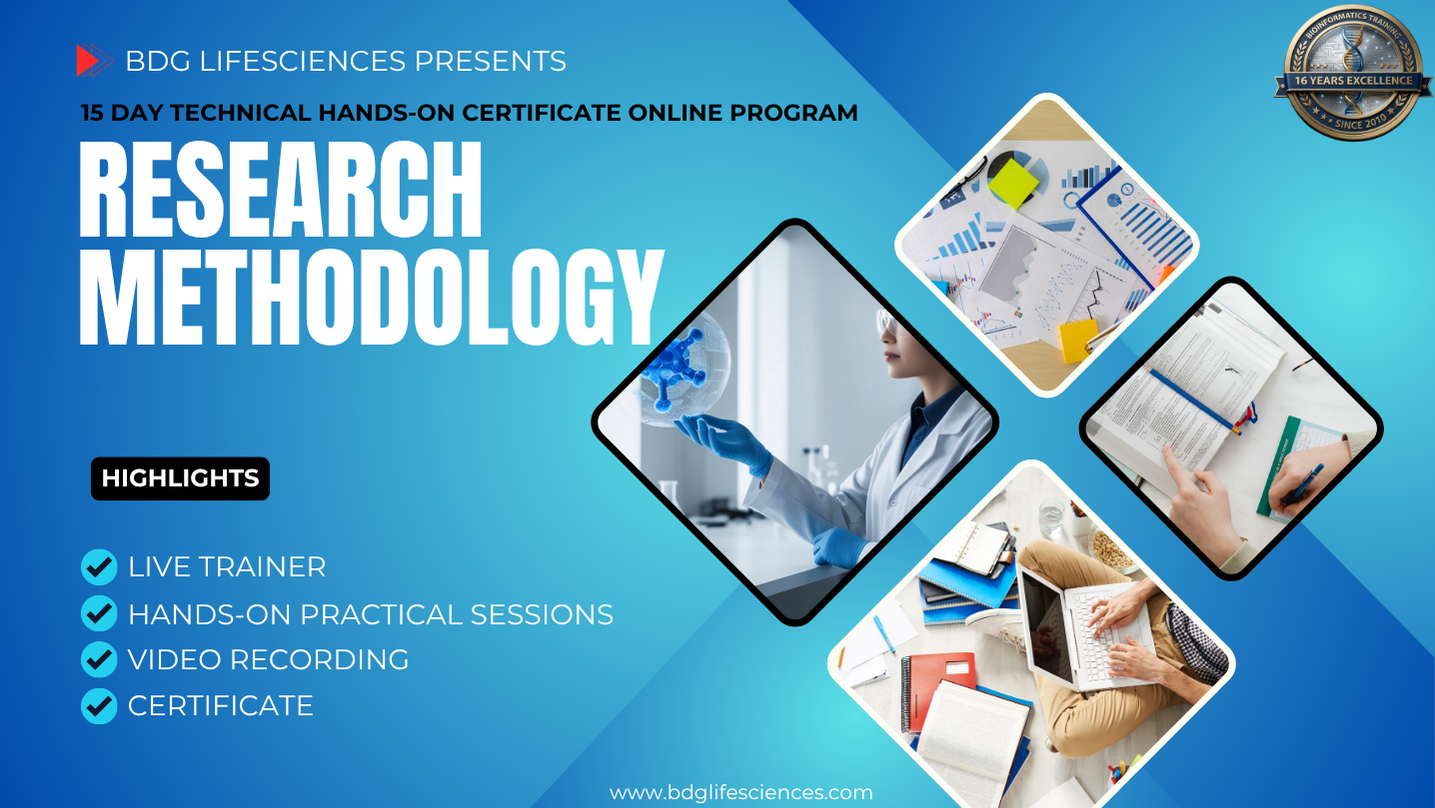
15-Day Program in Scientific Thinking, Data Analysis & Academic Writing for Science Fairs and College Applications
4.7
This Event Includes
- High demand video
- Learn from Experts
- Hands-on practical sessions
- Certificate on completion
Registration Fee |
|
In US $ |
240 |
Learn How Real Scientists Think, Investigate, and Make Discoveries
A school project demonstrates what a student has learned. A research project demonstrates how a student can think, investigate, analyse, and create new knowledge.
The difference between an ordinary project and meaningful scientific research is methodology — the structured framework scientists use to transform curiosity into a reliable investigation. Research methodology teaches students how to ask better questions, design meaningful studies, collect and interpret evidence, analyse information objectively, and communicate their findings professionally.
BDG Lifesciences' 15-Day Research Methodology Program for High School Students introduces students to the complete research process and develops the foundational skills required to conduct scientific investigations across disciplines. Unlike subject-specific courses focused only on biology, chemistry, or physics, this program teaches universal research skills applicable to every field, including STEM, medicine, social sciences, environmental studies, business, technology, and humanities.
Through fifteen live instructor-led sessions conducted online via Zoom, students are guided through the complete journey of research — from developing a scientific question to presenting research findings.
The program begins by developing scientific thinking and understanding the fundamentals of research, including the meaning and purpose of research, scientific curiosity, observation, evidence-based reasoning, empiricism, the relationship between theory and observation, and different approaches including descriptive, analytical, applied, fundamental, qualitative, and quantitative research.
Students then learn how researchers identify meaningful problems and convert ideas into structured investigations. Topics include developing research questions, evaluating feasibility, defining research scope, understanding variables, and creating scientifically testable hypotheses, including null and alternative hypotheses.
The program progresses into literature review and research planning, where students learn how scientists explore existing knowledge, identify research gaps, evaluate scientific sources, distinguish primary research articles from secondary literature, and understand the difference between research methods and research methodology. Students are also introduced to inductive and deductive reasoning and how scientists build logical arguments from evidence.
A major component of the program focuses on practical research execution, including data collection methods such as observations, surveys, interviews, and experiments. Students learn sampling concepts, including random, convenience, and stratified sampling, understand research bias, and explore how scientists maintain accuracy and reliability while recording data.
Students also develop foundational data analysis skills by learning how research findings are represented visually through graphs, charts, and tables. They are introduced to essential statistical concepts including mean, median, mode, range, frequency distributions, and the fundamentals of interpreting scientific data, including a conceptual introduction to Chi-square analysis.
The final stage of the program focuses on scientific communication. Students learn how professional researchers structure scientific reports, including title, abstract, introduction, methodology, results, discussion, and conclusion sections. They also learn citation basics, referencing, avoiding plagiarism and self-plagiarism, research ethics, responsible conduct of research, differences between research articles and review papers, and effective scientific presentations.
This program is designed for high school students who want to participate in science fairs, undertake independent research projects, strengthen university applications, develop critical thinking skills, or understand how real discoveries are made.
Sessions are delivered by trainers with research backgrounds in bioinformatics, computational biology, drug discovery, genomics, and life sciences. Several trainers have mentored students in scientific projects leading to science fair recognition and peer-reviewed publications.
Each session includes a written summary for revision, and recordings are provided so students can revisit concepts at their own pace. Students who successfully complete the program receive a Certificate of Completion from BDG Lifesciences.
The program also serves as an essential foundation for students interested in progressing into BDG Lifesciences' advanced mentored research projects and publication-oriented research programs.
Why High School Students Should Join This Research Methodology Program
Build the Foundation to Think Like a Scientist Before Entering University
Research is not only about conducting experiments — it is about learning how to think. The ability to ask meaningful questions, analyse evidence, solve problems logically, and communicate ideas clearly are skills that benefit students throughout their academic and professional journeys.
Most students are introduced to research only after entering university. This program gives high school students an early advantage by introducing them to the principles and practices used by scientists, researchers, and academics worldwide.
Unlike traditional classroom learning, where students often follow predefined experiments with known outcomes, this program teaches students how real research begins — with curiosity, uncertainty, investigation, and discovery.
Learn the Complete Research Journey
Students gain a complete understanding of how an idea becomes a scientific investigation:
- Identifying a meaningful research question
- Understanding existing knowledge through literature review
- Designing a research approach
- Collecting reliable data
- Analysing and interpreting results
- Writing scientific reports
- Presenting findings professionally
By understanding this complete process early, students become better prepared to undertake independent projects, science competitions, internships, and future university research.
Strengthen Science Fair Projects and Research Portfolios
Many students have interesting ideas but struggle to convert those ideas into structured research projects.
This program helps students move beyond simple demonstrations and develop projects with stronger scientific foundations by teaching:
- How to formulate research questions
- How to design investigations
- How to avoid common research mistakes
- How to analyse results objectively
- How to present findings clearly
These skills can significantly improve the quality and impact of science fair projects and research portfolios.
Develop Skills Required for Future Academic Success
Universities increasingly value students who demonstrate curiosity, independent thinking, and the ability to engage with complex problems.
Early exposure to research methodology helps students develop:
- Critical thinking
- Problem-solving abilities
- Analytical reasoning
- Scientific communication
- Evidence-based decision-making
These skills are valuable not only for science but also for medicine, engineering, technology, business, law, and many other disciplines.
Build Strong Foundations for Future Research Work
The purpose of this program is not simply to teach students how to complete one project. It is designed to build the foundation required for future research.
By understanding how researchers formulate questions, evaluate evidence, design studies, and communicate discoveries, students develop the mindset needed for advanced scientific work.
This foundation prepares students for future undergraduate research projects, laboratory experiences, science competitions, internships, and advanced mentored research programs.
Prepare for a Future Driven by Innovation
The world's biggest challenges — from healthcare and climate change to artificial intelligence and technology — require people who can think critically, investigate systematically, and create evidence-based solutions.
Research methodology provides students with the framework to become problem solvers, innovators, and future leaders in science and beyond.
Frequently Asked Questions (FAQs)
1. What is research methodology, and why should high school students learn it?
Research methodology is the structured process scientists use to investigate questions, collect evidence, analyse information, and communicate discoveries. Learning research methodology during high school helps students develop scientific thinking, critical reasoning, and problem-solving skills before entering university.
It provides students with the foundation required to conduct meaningful projects, participate in science fairs, prepare research portfolios, and approach academic challenges with a researcher’s mindset.
2. Is this Research Methodology program only for science students?
No. This program is designed for students from all academic interests.
Research methodology is a universal skill applicable to biology, chemistry, physics, medicine, engineering, computer science, environmental science, psychology, social sciences, business, law, and humanities.
The program teaches students how to think and conduct research rather than focusing on one specific subject area.
3. Is this program suitable for students with no previous research experience?
Yes. The program is specifically designed for beginners.
Students do not need prior experience conducting research, writing scientific papers, or analysing data. The course begins with the fundamentals of scientific thinking and gradually introduces advanced concepts through structured live instruction.
4. What will students learn by completing this program?
By the end of the program, students will understand how to:
- Identify research problems
- Develop research questions
- Create hypotheses
- Conduct literature reviews
- Design research approaches
- Collect and organize data
- Understand sampling methods
- Analyse results
- Create scientific graphs
- Write structured research reports
- Present scientific findings professionally
5. How does this program help students with science fairs?
Science fairs require more than an interesting idea. Successful projects require clear research questions, appropriate methodology, reliable data collection, logical analysis, and effective communication.
This program teaches students the complete research framework needed to transform ideas into structured scientific investigations and present their work more professionally.
6. Does this program include statistics?
Yes. The program introduces statistics at a level appropriate for high school students.
Students learn essential concepts including:
- Mean, median, and mode
- Range and frequency distributions
- Data organization
- Graphical representation
- Interpretation of research data
- Conceptual understanding of Chi-square analysis
No previous statistics knowledge is required.
7. Do students learn scientific writing?
Yes. Scientific communication is an important part of the program.
Students learn how researchers structure scientific reports, including:
- Title
- Abstract
- Introduction
- Methodology
- Results
- Discussion
- Conclusion
They are also introduced to referencing, citations, plagiarism prevention, and responsible research practices.
8. Is this program useful for university applications?
Yes. Completing a structured research methodology program demonstrates initiative, intellectual curiosity, and commitment to academic development.
The skills gained can strengthen student portfolios, scholarship applications, science competition participation, and future research opportunities.
9. Is this program a prerequisite for BDG Lifesciences' mentored research projects?
Yes. This program serves as a foundation for BDG Lifesciences' advanced mentored research and publication-oriented programs.
Students who understand research methodology are better prepared to undertake longer-term independent projects involving scientific investigation, data analysis, and research communication.
10. How long is the program and how are sessions conducted?
The program consists of 15 consecutive live sessions conducted through Zoom.
Each session lasts approximately 90–120 minutes and includes expert instruction, practical examples, discussion, and learning activities.
Session summaries and recordings are provided after each class for revision.
11. Will students receive a certificate after completing the program?
Yes. Students who successfully complete the program receive a Certificate of Completion from BDG Lifesciences.
The certificate can be included in academic portfolios, research profiles, university applications, and future resumes.
12. Are recordings provided after every session?
Yes. All sessions are recorded and shared with participants.
Students can revisit lessons, review important concepts, and strengthen their understanding after completing the live sessions.
13. What is the course fee and what does it include?
The program fee is $ 240 US and includes:
- 15 live instructor-led sessions
- Expert guidance throughout the program
- Session summaries
- Access to session recordings
- Certificate of Completion from BDG Lifesciences
14. Why is the registration fee charged in Australian Dollars (AUD) if the program fee is listed in USD?
Registration and payment are processed through Humanitix, our Australian payment platform. The ticket price displayed in AUD at checkout is equivalent to the USD program fee based on the prevailing exchange rate at the time of payment.
15. Why choose BDG Lifesciences for Research Methodology Training?
BDG Lifesciences has been delivering scientific education, research training, and mentoring programs since 2010.
Through its experience in bioinformatics, computational biology, drug discovery, genomics, and life sciences research, BDG Lifesciences provides students with structured exposure to real scientific thinking and research practices used globally.
How To Register
To secure your spot:
- Click on Register Now button and proceed.
- After registering, please email to info@bdglifesciences.com with your preferred start date and choose one of the following time slots: 5 AM–9 AM or 5 PM-9:30 PM EDT/CDT/PDT.
- Once you register, please allow us 2-5 working days to make your training schedule, i.e. dates and time.
- For any further queries, feel free to email us at info@bdglifesciences.com
⚠️ Important Eligibility Notice
This program has been exclusively designed for High School Students (typically Grades 8–12 or equivalent) and their parents.
If you are a university student, researcher, faculty member, working professional, or belong to any category other than a high school student, please do not register for this program. BDG Lifesciences offers separate training programs specifically designed for undergraduate students, postgraduate students, researchers, faculty members, and industry professionals.
Please ensure you are registering for the correct program before completing your payment.
Registration fees for this program are strictly non-refundable and non-transferable. Registrations made by participants outside the intended eligibility criteria may be cancelled without refund or transfer to another program.
To get regular updates on Upcoming Job opportunities, Research Projects, Courses, Training and Trainings, kindly join our WhatsApp Channel / Telegram
You should also read the Terms & Conditions page as well as the FAQs page. For any assistance kindly chat with our AI Assistant BioBot on the website www.bdglifesciences.com
