More
Beyond the 100-Day Mission: How AI and Reverse Vaccinology are Pre-empting Future Pandemics
11 May , 2026
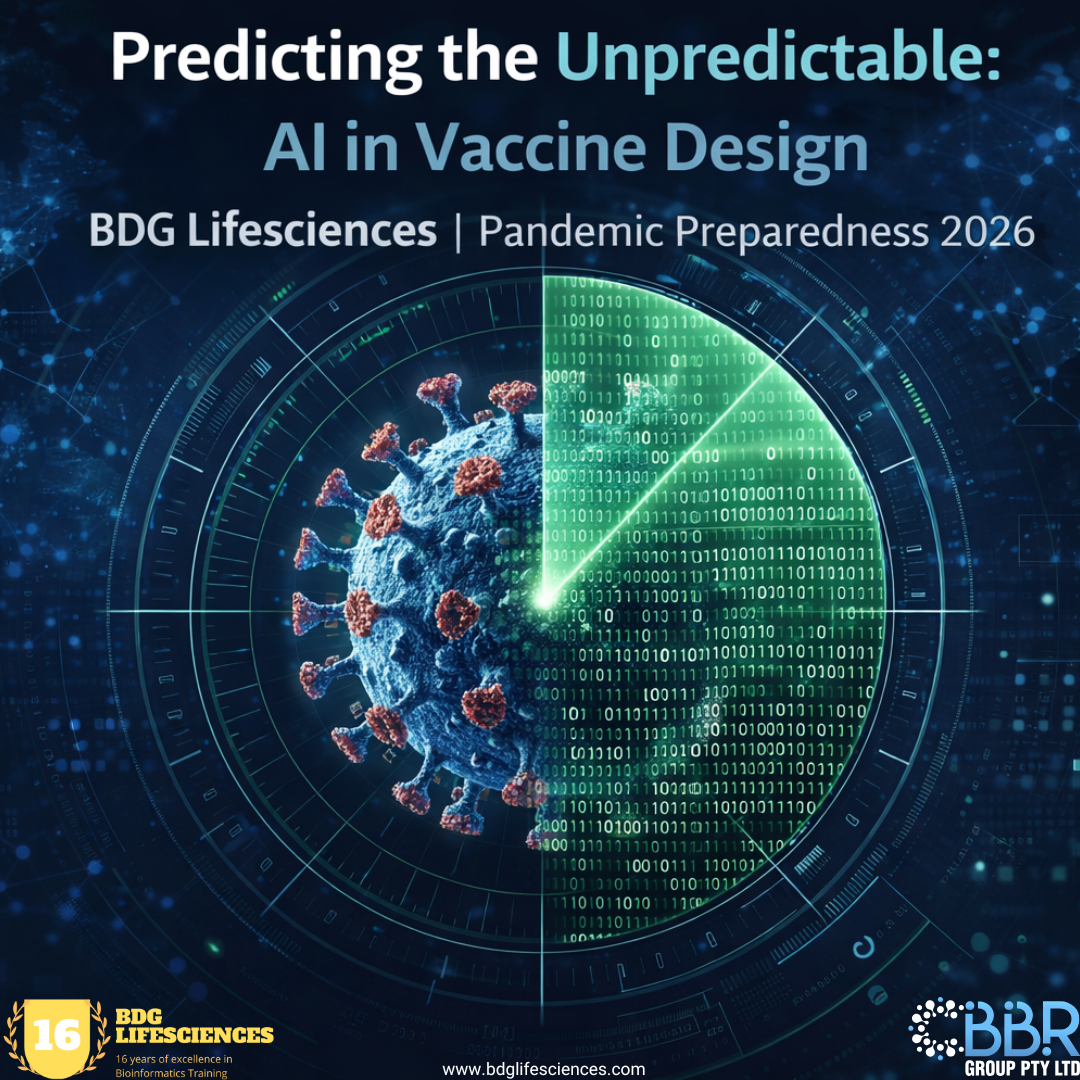
The COVID-19 pandemic taught the world a hard lesson: we cannot afford to be reactive. In the past, vaccine development was a race against a clock that had already started. But as we move through 2026, the goalposts have shifted. We aren't just trying to catch up to viruses; we are trying to meet them at the finish line before they even emerge.
At the heart of this shift is Immunoinformatics—the powerhouse intersection of immunology, computer science, and big data.
The Shift to Reverse Vaccinology 2.0
Traditional vaccinology relied on growing pathogens in the lab—a slow, dangerous, and often hit-or-miss process. Reverse Vaccinology (RV) flipped the script by starting with the genome. Today, we’ve entered the era of RV 2.0, where we don't just scan genomes; we use Generative AI to design synthetic immunogens that never existed in nature but provide broader protection than any natural infection could.
How We Are Staying One Step Ahead:
Predicting "Immune Escape": Using tools like EVEscape and R-DELF (Deep Evolutionary Learning), researchers can now model how a virus is likely to mutate months before the mutation appears in the population. This allows us to create "variant-proof" vaccines that target the parts of a virus that cannot change without killing it.
Epitope Mapping at Scale: Identifying which part of a virus triggers the strongest immune response (the epitope) used to take years of wet-lab work. Immunoinformatics algorithms now predict B-cell and T-cell epitopes with 99%+ accuracy in seconds.
The Rise of "Inverse Vaccinology": In 2026, we are seeing the first "inverse" designs—where AI defines the desired immune outcome first, and then works backward to engineer the exact molecular structure needed to achieve it.
The Global Vaccine Library
One of the most ambitious projects of 2026 is the creation of a Global Vaccine Library. By using computational biology to pre-design vaccine candidates for all 25 known virus families that infect humans, we are essentially "pre-loading" our defenses. If a new pathogen emerges, we won't start from scratch; we’ll pull the blueprint from the digital shelf.
At BDG Lifesciences, we are committed to training the scientists who will manage these digital arsenals. The next pandemic isn't an "if"—it's a "when"—and for the first time in history, we have the tools to be ready before it begins.
The future of global health is being built on data. Follow BDG Lifesciences to stay updated on the latest breakthroughs in Biosafety, Immunoinformatics, and the AI-driven battle against infectious diseases.