More
Precision Molecular Docking & Hybrid Drug Discovery 2026
02 Jun , 2026
In the hierarchy of drug discovery, Molecular Docking remains the bridge between a theoretical hit and a biological reality. However, the methodology of 2026 is a far cry from the rigid-body approximations of the last decade.
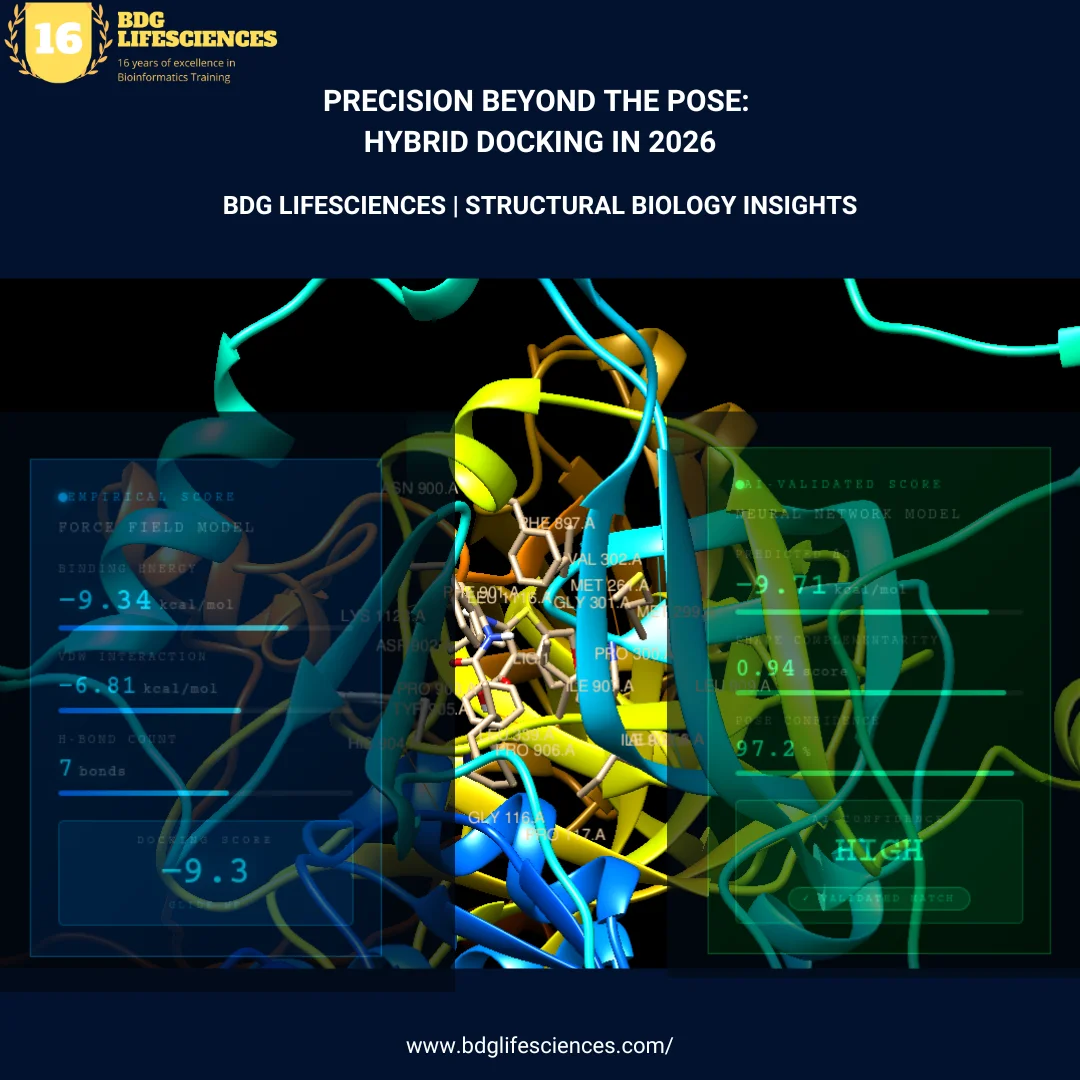
The challenge in contemporary docking isn't just "finding a pose"—it’s accurately predicting the binding free energy (ΔG) in a way that correlates with in vitro IC50 values. At BDG LifeSciences, we are witnessing a paradigm shift: the rise of Hybrid Virtual Screening.
The 2026 Technical Stack: Physics Meets AI
The industry has moved beyond relying on a single scoring function. Today’s gold standard involves a three-tiered pipeline:
High-Throughput Virtual Screening (HTVS): Utilizing optimized engines like AutoDock Vina or Glide to screen libraries of 107 compounds. The focus here is on speed and geometric complementarity.
AI-Driven Rescoring: Traditional empirical scoring functions often struggle with "false positives." We are now integrating AI foundation models like Boltz-2 and ArtiDock. These models, trained on the massive PLINDER dataset, have shown a 30% increase in ROC-AUC values by learning the nuances of protein-ligand interactions that physics-based equations sometimes miss.
Molecular Dynamics (MD) Validation: A docking pose is a snapshot; biology is a movie. To confirm stability, we subject top "hits" to GROMACS simulations to observe the Induced Fit and ensure the ligand remains within the binding pocket under physiological conditions.
The Breakthrough: Induced Fit & Protein Flexibility
One of the most significant advancements this year is the democratization of Flexible Receptor Docking. Previously computationally prohibitive, new GPU-accelerated algorithms allow us to model side-chain flexibility in real-time. This is crucial for "undruggable" targets where the binding pocket is cryptic or highly dynamic.
Why Accuracy Matters
In 2026, the cost of a failed wet-lab synthesis is higher than ever. By utilizing a Consensus Scoring approach—combining classical physics, machine learning rescoring, and ADMET prediction—BDG Lifesciences helps researchers reduce "dry-lab to wet-lab" attrition rates by up to 50%.
Is your docking pipeline producing too many false positives? Join our Molecular Docking Certificate Online Workshop of 10 Days which we are conducting since 2012. Register now for expert insights into hybrid virtual screening and the next generation of structure-based drug design.