More
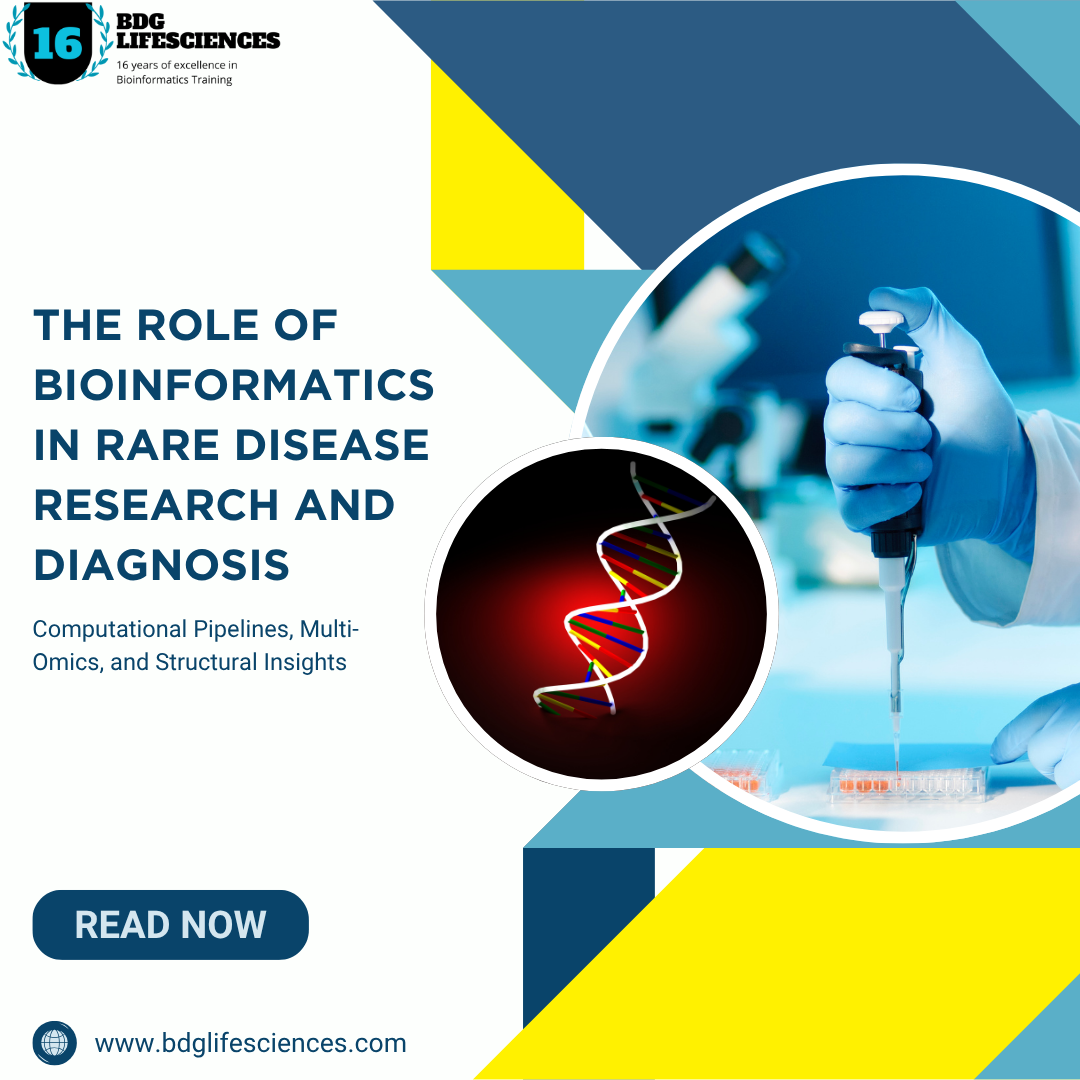
The Role of Bioinformatics in Rare Disease Research and Diagnosis: Computational Pipelines, Multi-Omics, and Structural Insights
03 Nov , 2026
The Role of Bioinformatics in Rare Disease Research and Diagnosis: Computational Pipelines, Multi-Omics, and Structural Insights
What is the Role of Bioinformatics in Rare Disease Diagnosis and Research?Bioinformatics decodes rare diseases by transforming high-throughput genomic, transcriptomic, and multi-omic data into actionable clinical insights. Using graph-based alignment, variant pathogenicity predictors, and molecular dynamics, it resolves the diagnostic odyssey, clarifies variants of uncertain significance (VUS), and uncovers druggable structural targets for historically intractable monogenic and oligogenic disorders. |
Resolving the Diagnostic Odyssey: Genomic Orchestration at Scale
Over 300 million individuals globally live with one of approximately 7,000 to 10,000 recognized rare conditions, of which roughly 80% are monogenic or possess a primary genetic etiology. The historical “diagnostic odyssey” averages 4.8 years, involves multiple clinical evaluations, and yields a high rate of initial misdiagnosis. Bioinformatics serves as the core engine driving turnaround times down from years to hours.
Over 300 millionindividuals globally live with a rare condition |
7,000–10,000recognized rare conditions |
~80%monogenic or primary genetic etiology |
4.8 yearsaverage diagnostic odyssey |
|||
 |
Share of rare conditions with a primary genetic etiology
Chart basis: the roughly 80% figure is from the text above; the ~20% remainder is derived as 100% − 80%. |
Diagnostic pipeline: from raw reads to prioritized genes
IN |
Raw Reads (FASTQ) |
|
1 |
Graph Aligners: vg / Giraffe / DRAGEN |
|
2 |
Small Variant Calling: DeepVariant / Sentieon |
|
3 |
Long-Read Profiling: Sniffles2 / Severus |
|
4 |
Integrated Clinical Phenotyping: HPO-Lirical / Exomiser |
|
Graph Pangenomics and Reference Bias Mitigation
Standard read alignment against linear references (GRCh37/GRCh38) routinely fails in hypervariable loci, structural breakpoints, and segmental duplications. Current state-of-the-art workflows deploy pangenome variation graphs through toolkits such as vg and Giraffe.
By projecting short- and long-read data onto variation graphs incorporating diverse haplotypes (including Telomere-to-Telomere consortium baselines like T2T-CHM13), bioinformaticians eliminate mapping artifacts. This increases alignment accuracy across complex rare disease loci (e.g., SMN1/SMN2 in spinal muscular atrophy and CYP21A2 in congenital adrenal hyperplasia) by up to 14% compared to standard BWA-MEM alignments.
High-Throughput Variant Calling Architectures
To achieve ultra-rapid clinical turnarounds (sub-24-hour critical NICU sequencing):
|
Neural Callers |
Hardware Acceleration |
|
Chart: 30× short-read WGS analysis runtime (minutes)
|
Before: ~10 hours |
|
~600 min |
|
|
After: under 30 minutes |
|
< 30 min |
|
Chart basis: the runtimes quoted in the Hardware Acceleration card, with ~10 hours converted to ~600 minutes. Bar length is proportional to minutes.
Advanced Variant Prioritization and the VUS Dilemma
The primary bottleneck in clinical genomics is no longer data acquisition; it is resolving the tens of thousands of Variants of Uncertain Significance (VUS) generated per genome.
Deep Missense PredictorsPrimary Toolsets |
Non-Coding & SplicingPrimary Toolsets |
|
Long-Read Structural CallersPrimary Toolsets |
Phenotype-Driven PrioritizersPrimary Toolsets |
|
Non-Coding and Deep Intronic Pathogenicity
Between 15% and 25% of unresolved rare monogenic cases stem from mutations outside canonical coding exons. Dilated convolutional architectures such as SpliceAI analyze sequence contexts up to 10 kilobases away from target sites, accurately pinpointing:
|
Phenotypic Matching via Ontologies
Computational pipelines convert clinical text into standardized HPO terms. Algorithms like Exomiser compute semantic similarity scores between clinical presentations and model organism phenotypes (cross-species analysis with MGI and ZFIN databases), isolating causal alleles even when identical variants have never been logged in ClinVar or gnomAD.
Beyond Monogenic Models: Multi-Omics Integration
Genomics provides the baseline architecture, but cellular function requires multi-dimensional validation. Modern diagnostic yields increase by 10–35% through integrated multi-omic pipelines.
|
Patient Biospecimen |
RNA-SeqAberrant Splicing / ASE / Expression Outliers (FRASER / OUTRIDER) |
EpigenomicsDNA Methylation Epi-signatures (Illumina EPIC / Nanopore 5mC) |
ProteomicsDIA-MS Peptide Abundance / Protein Complex Destabilization |
||
A |
Multi-Omic Latent Space Integration |
|
B |
Definitive Molecular Diagnosis |
|
Transcriptomics (RNA-Seq)
RNA sequencing confirms downstream functional consequences of suspected non-coding variants:
|
Aberrant Expression |
Aberrant Splicing |
|
Epigenetic “Epi-Signatures”
Chromatin remodelers and histone-modifying enzymes account for a large swath of neurodevelopmental rare diseases (e.g., Kabuki syndrome, CHARGE syndrome). Microarray and direct long-read native methylation profiling (Oxford Nanopore / PacBio HiFi) reveal diagnostic episignatures: distinct, stable DNA methylation patterns that act as functional barcodes for variants within specific chromatin-modifying genes, bypassing the need to interpret ambiguous VUS findings.
Proteomics Integration
Data-Independent Acquisition Mass Spectrometry (DIA-MS) quantifies post-translational variations, protein degradation pathways, and altered quaternary complexes. Integrated multi-omic autoencoders (e.g., MOFA+) synthesize proteomic, transcriptomic, and genomic layers into unified latent vectors, identifying functional disruptions across pathways rather than isolated genes.
Structural Bioinformatics and In Silico Drug Repurposing
For rare disease patients, receiving a molecular diagnosis is only the initial step; over 95% of rare diseases possess no regulatory-approved targeted therapy. Structural bioinformatics bridges the gap from causal etiology to actionable pharmacology.
High-Fidelity Protein Modeling
Equivariant structural networks (e.g., AlphaFold3, ESMFold) model patient-specific mutant alleles with atomistic precision. Structural biologists inspect:
|
Enhanced Molecular Dynamics (MD)
Static structures often miss the dynamic implications of pathogenic mutations. Explicit solvent Molecular Dynamics running on CUDA-optimized GROMACS or OpenMM frameworks compute:
|
Drug repurposing pipeline
IN |
Target Structure (Mutant Model) |
|
1 |
Pharmacophore Screening |
|
2 |
Ensemble Molecular Docking |
|
3 |
Free-Energy Perturbation (FEP) |
|
OUT |
Repurposed Clinical Candidate Ready for Preclinical Validation |
|
In Silico Therapeutics and Orphan Drug Repurposing
Computational phenotyping pairs directly with drug repositioning engines:
|
Network Medicine |
Virtual Screening |
|
Overcoming Obstacles: Privacy, Compute, and Federation
Clinical translation of advanced bioinformatics pipelines requires navigating infrastructure and governance constraints:
1 |
Sparsity of Training Sets |
|
2 |
Data Privacy and Sovereignty |
|
3 |
High-Performance Computing (HPC) Demands |
|
Accelerate Your Translational Pipelines with BDG Lifesciences
Translating high-dimensional biological data into clinical clarity requires computational precision, robust infrastructure, and deep domain expertise. BDG Lifesciences empowers biotechnology organizations, academic centers, and enterprise R&D groups to navigate the complexities of modern genomics and drug discovery.
Custom Bioinformatics ServicesFrom high-throughput pangenomic variant discovery and multi-omic data integration to AI-powered structural biology, our dedicated pipelines yield publication-ready, actionable insights. Explore our end-to-end analytical solutions on our Bioinformatics Services platform. |
Specialized Enterprise TrainingClose the computational skills gap across your research and clinical teams. We design and deliver advanced, hands-on masterclasses covering Nextflow pipeline architecture, structural bioinformatics, molecular dynamics, and multi-omics. Discover our curriculum on our Corporate Training page. |
|
|
Partner with BDG Lifesciences to convert raw sequencing data into therapeutic breakthroughs. |
Frequently Asked Questions (FAQs)
1 |
How does long-read sequencing improve rare disease bioinformatics pipelines? |
|
2 |
What is the difference between VUS classification and pathogenic variant calling? |
|
3 |
How does RNA-Seq increase the diagnostic yield in rare diseases? |
|
4 |
Can bioinformatics pipelines facilitate targeted therapies for ultra-rare conditions? |
|
References
|
1. |
SpliceAI & Deep Learning in Splicing: Jaganathan, K., et al. (2019). Predicting Splicing from Primary Sequence with Deep Learning. Cell, 176(3), 535-548. DOI: 10.1016/j.cell.2018.12.015 |
|
2. |
Structural Missense Prediction: Cheng, J., et al. (2023). Accurate proteome-wide missense variant effect prediction with AlphaMissense. Science, 381(6664), eadg7492. DOI: 10.1126/science.adg7492 |
|
3. |
Pangenomic Graph Realization: Hickey, G., et al. (2023). Pangenome graph construction from genome alignments with Minigraph-Cactus. Nature Biotechnology, 42(3), 463–473. DOI: 10.1038/s41587-023-01793-w |
|
4. |
RNA-Seq Diagnostic Integration: Yepez, V. A., et al. (2022). Clinical implementation of RNA sequencing for Mendelian disease diagnostics. Genome Medicine, 14(1), 38. DOI: 10.1186/s13073-022-01043-x |
|
5. |
Epi-Signatures in Diagnosis: Sadikovic, B., et al. (2021). Clinical Epigenomics: Genome-Wide DNA Methylation Analysis for the Diagnosis of Mendelian Disorders. Human Genetics, 140(5), 725–741. DOI: 10.1007/s00439-020-02220-4 |
|
6. |
Ultra-Rapid Genomic Diagnostics: Gorzynski, J. E., et al. (2022). Ultrarapid Nanopore Genome Sequencing in a Critical Care Setting. New England Journal of Medicine, 386(7), 700-702. DOI: 10.1056/NEJMc2112090 |