More
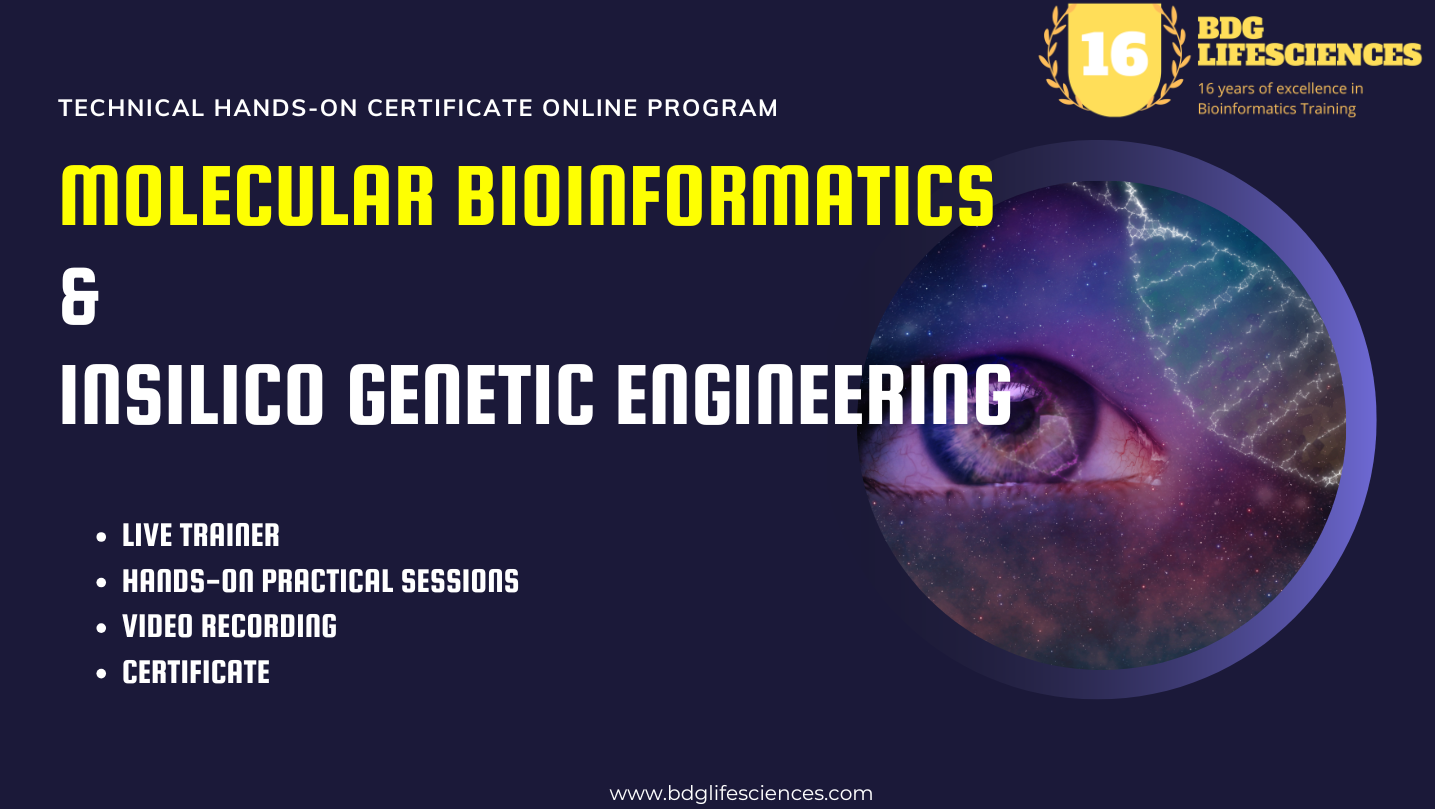
Molecular Bioinformatics & Insilico Genetic Engineering Certificate Workshop
Master 18 real-world insilico applications — from gene annotation and ORF prediction to homology modelling, protein mutagenesis, primer designing, and restriction mapping — all on your own computer.
4.7
This Event Includes
- High demand video
- Learn from Experts
- Hands-on practical sessions
- Certificate on completion
Registration Fee |
|
In US $ |
$ 99 |
In Indian Rupees |
₹ 9405 |
Understanding the Field
What is Molecular Bioinformatics & Insilico Genetic Engineering?
Molecular Bioinformatics is the application of computational tools and algorithms to analyze, model, and interpret biological molecules — DNA, RNA, and proteins — at a molecular level. It bridges classical molecular biology with the power of modern computing to answer fundamental questions in genetics, structural biology, and drug discovery.
Insilico Genetic Engineering refers to the use of computational methods to simulate and design genetic manipulations — predicting gene structure, manipulating protein sequences, designing primers, modelling 3D protein structures, and analyzing mutations — entirely on a computer, before any wet lab experiment. This dramatically accelerates research, reduces costs, and enables discoveries that would be impossible through laboratory experiments alone.
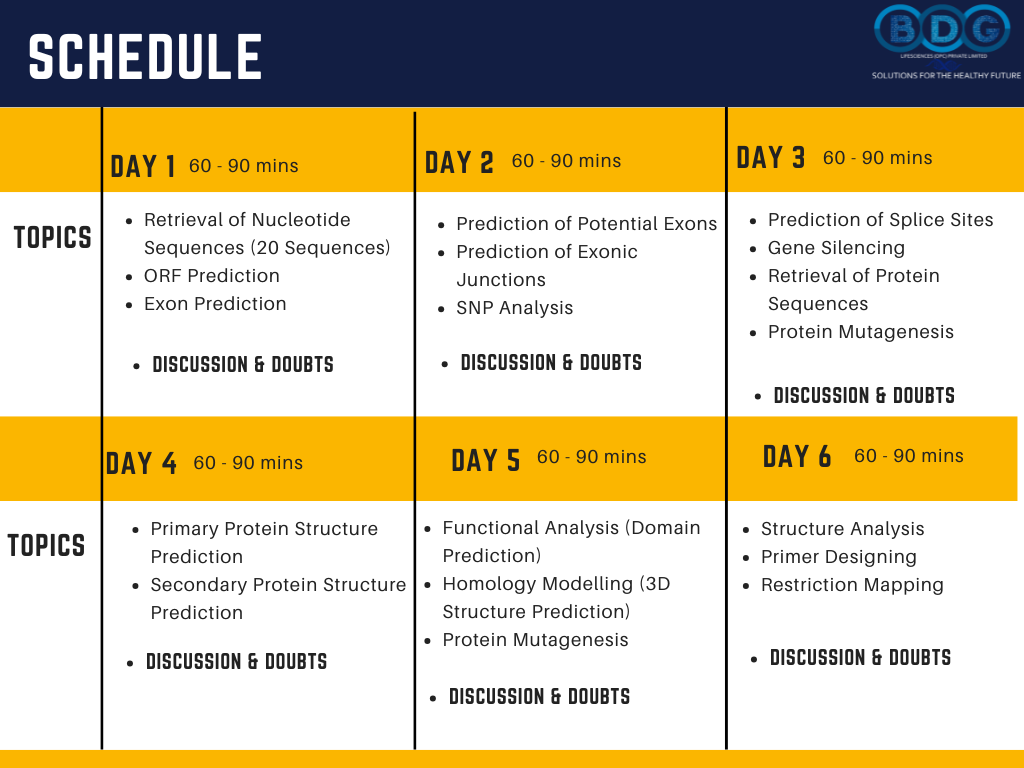
Together, these two disciplines form one of the most powerful skill sets in modern life sciences — applicable to drug discovery, cancer research, agricultural biotechnology, personalized medicine, and synthetic biology. This workshop gives you hands-on proficiency in both, through 18 structured practical applications over 6 days.
Workshop Dates
7 to 12 November, 2026. Live trainer will take online sessions from 9 PM - 10:30 PM India time +5:30 GMT on Zoom.
What You Will Do in This Workshop
- Retrieve & analyze nucleotide and protein sequences computationally
- Predict gene structure — ORFs, exons, splice sites & junctions
- Perform SNP analysis and gene silencing simulations
- Model protein mutations and predict primary, secondary & 3D structures
- Predict protein domains and functional characteristics
- Design oligonucleotide primers for PCR experiments
- Perform restriction enzyme mapping for cloning strategies
- All 18 applications run on your own laptop — no lab required
Program Overview
What This Insilico Bioinformatics Workshop Covers
A 6-day comprehensive online training program delivering 18 real-world insilico applications in molecular bioinformatics and computational genetic engineering — all on your own computer, with live expert guidance every session.
⏱️ 60–90 Mins Live Daily- Six days of focused, interactive live sessions — each covering distinct molecular bioinformatics applications with real-time expert guidance and Q&A.
💻 Work on Your Own System- Every application is run on your own Windows, Mac, or Linux computer. No specialized hardware or institutional server access required.
🔴 Live BDG Lifesciences Experts- Sessions are conducted live by BDG Lifesciences' experienced bioinformatics team — real-time instruction, not pre-recorded content.
🧬 18 Hands-On Applications- The most comprehensive insilico curriculum available — covering gene structure prediction, protein modelling, mutagenesis, primer design, and more.
🎥 Session Recordings Included- All 6 sessions are recorded and shared after class for self-paced revision — revisit any application as many times as needed.
🏅 Certificate on Completion- Earn a verified BDG Lifesciences certificate with a unique barcode upon successfully completing all assigned practical tasks.
Core Topics
4 Pillars of the Workshop Curriculum
The workshop is structured around four foundational topics in molecular bioinformatics — each building the conceptual framework for the 18 hands-on practical applications you will perform.
- Overview of Genes & Proteins — Structures- Foundational understanding of gene and protein structure — the central molecules of molecular biology. Covers nucleotide sequence organization, gene architecture, and the structural hierarchy of proteins from primary to quaternary levels, providing the essential context for all insilico analyses in the workshop.
- Central Dogma of Molecular Biology- The fundamental principle governing the flow of biological information — from DNA to RNA to protein. Understanding transcription, translation, splicing, and post-translational modifications is essential for interpreting the outputs of ORF prediction, exon prediction, and gene annotation tools used in the workshop.
- Introduction to Gene Annotation- Gene annotation is the process of identifying the location, structure, and function of genes within a genome. This topic covers computational approaches to annotating nucleotide sequences — identifying coding regions, exon-intron boundaries, splice sites, and functional elements — using bioinformatics databases and prediction tools.
- Introduction to Gene Manipulation- Insilico gene manipulation covers the computational design and simulation of genetic modifications — including mutagenesis, gene silencing, and primer design for cloning and PCR. This topic bridges the gap between computational prediction and experimental molecular biology, preparing participants to design real experiments using insilico tools.
Hands-On Applications
18 Insilico Practical Applications You Will Perform
This is the most comprehensive insilico molecular bioinformatics practical curriculum available in a single workshop — covering the full spectrum from nucleotide sequence analysis to protein 3D structure prediction and experimental design tools..
- Retrieval of Nucleotide Sequences- Retrieve 20 sequences from NCBI databases — the starting point for all downstream gene analysis.
- ORF Prediction- Identify Open Reading Frames within nucleotide sequences to locate potential protein-coding regions.
- Exon Prediction- Computationally predict exonic regions within genomic DNA sequences using bioinformatics tools.
- Prediction of Potential Exons- Advanced exon detection — identifying candidate exonic regions in unannotated genomic sequences.
- Prediction of Exonic Junctions- Identify exon-exon junction sites critical for understanding alternative splicing and mRNA processing.
- SNP Analysis- Computationally identify and analyze Single Nucleotide Polymorphisms and their potential functional effects.
- Prediction of Splice Sites- Identify donor and acceptor splice sites in pre-mRNA sequences — essential for understanding gene expression regulation.
- Gene Silencing- Computationally design and evaluate gene silencing strategies — siRNA design and RNAi target site prediction.
- Retrieval of Protein Sequences- Retrieve target protein sequences from UniProt and NCBI databases for downstream structural analysis.
- Protein Mutagenesis- Simulate point mutations in protein sequences insilico — predict structural and functional consequences.
- Primary Protein Structure Prediction- Analyze amino acid composition, physicochemical properties, and primary structural features of proteins.
- Secondary Protein Structure Prediction- Predict alpha helices, beta sheets, turns, and coils — key secondary structural elements from sequence alone.
- Functional Analysis — Domain Prediction- Identify conserved functional domains and motifs within protein sequences using InterPro and Pfam databases.
- Homology Modelling — 3D Structure Prediction- Build three-dimensional protein models using comparative homology modelling — a core computational drug design technique.
- Protein Mutagenesis (Advanced)- Advanced insilico mutagenesis — design and evaluate engineered protein variants for improved stability or function.
- Structure Analysis- Analyze and visualize 3D protein structures — identifying active sites, binding pockets, and structural features.
- Primer Designing- Design optimal PCR primers insilico — specifying melting temperature, GC content, and amplicon characteristics.
- Restriction Mapping- Perform insilico restriction enzyme analysis — identify cut sites for cloning strategies and recombinant DNA design.
Software & Databases
Bioinformatics Tools & Databases You Will Learn
Gain hands-on proficiency with the globally trusted bioinformatics tools, databases, and platforms used in molecular biology research institutions, biotech companies, and academic labs worldwide..
🔬 NCBI & UniProt Databases- The world's primary repositories for nucleotide and protein sequence data. You will retrieve, navigate, and analyze sequences from NCBI GenBank and UniProt for all downstream applications. Sequence Retrieval
🧬 ORF & Exon Prediction Tools- Computational tools for identifying Open Reading Frames, predicting exon boundaries, exon-intron junctions, and splice sites from raw genomic DNA sequences. Gene Structure Analysis
🔷 Protein Structure Prediction Servers- Online platforms for predicting primary, secondary, and tertiary protein structures — including homology modelling servers for building 3D protein models from sequence data. Structural Bioinformatics
🏷️ InterPro & Pfam — Domain Databases- Tools and databases for identifying conserved protein domains, functional motifs, and structural features — critical for understanding protein function from sequence alone. Functional Annotation
🧪 Primer Design & SNP Analysis Tools- Bioinformatics tools for designing optimal PCR primers, analyzing SNP variants, simulating gene silencing strategies, and evaluating protein mutagenesis outcomes insilico. Gene Manipulation
✂️ Restriction Enzyme Analysis Tools- Insilico restriction mapping tools for identifying enzyme cut sites, designing cloning strategies, and planning recombinant DNA experiments before any wet lab work begins. Cloning Strategy Design
System Requirement: Any OS — Windows, Mac (macOS), or Ubuntu/Linux — with a stable internet connection. All software installation and tool access is guided by the trainer from Day 1.
What You Will Achieve
Learning Outcomes After This Workshop
By Day 6, you will have independently performed all 18 insilico applications — giving you a complete, demonstrable skill set in computational molecular biology and genetic engineering
.🧬 Analyze Gene Structure Computationally- Independently predict ORFs, exons, splice sites, and exonic junctions from nucleotide sequences using standard bioinformatics tools.
🔬 Perform Insilico Gene Manipulation- Design gene silencing strategies, simulate SNP effects, and model protein mutations computationally — without setting foot in a wet lab.
🏗️ Build & Analyze 3D Protein Models- Use homology modelling to predict tertiary protein structures, visualize active sites, and analyze structural consequences of mutations.
🖼️ Generate Publication-Quality Outputs- Produce structure visualization images, protein domain maps, and sequence analysis outputs suitable for academic publications and research reports.
🧪 Design Real Experiments Insilico- Design PCR primers and restriction mapping strategies computationally — directly applicable to real molecular cloning and PCR experiments in the lab.
🏅 Earn a Verified Certificate- Receive a BDG Lifesciences certificate with a unique barcode — a credible, verifiable addition to your academic and professional profile.
Your Instructors
Taught by BDG Lifesciences' Expert Team
This workshop is conducted by BDG Lifesciences' experienced team of bioinformatics trainers and computational biologists — researchers who are actively involved in bioinformatics projects, molecular modelling research, and life sciences education. Each trainer brings a combination of academic research expertise and industry-relevant practical skills, ensuring that every session delivers not just theoretical knowledge, but real-world applicability.
Our expert team has collectively trained thousands of participants across 40+ countries over 16+ years — consistently receiving over 90% positive feedback for structured delivery, hands-on methodology, and participant-centered teaching. They specialize in making complex computational tools accessible and intuitive, regardless of a participant's prior experience level. Every trainer is committed to ensuring that each of the 18 practical applications is executed successfully by every participant.
Who Should Attend
This Workshop Is Designed For
From undergraduate students to experienced researchers and biotech entrepreneurs — this program delivers insilico bioinformatics skills relevant to every stage of a life sciences career.
🎓 Students & Faculty
- B.Sc., M.Sc. & Ph.D. students in bioinformatics
- Biotechnology & Genetics students
- Molecular Biology & Life Sciences students
- Faculty incorporating computational tools into teaching
- Professors expanding research into bioinformatics
🏭 Industry & Healthcare Professionals
- Biotech & pharma professionals in drug discovery
- Genomics & genetic engineering industry scientists
- Healthcare professionals in genomic medicine
- Molecular diagnostics professionals
- Biotech entrepreneurs & startup innovators
🏥 Researchers & Scientists
- Academic researchers in molecular biology labs
- Research institute scientists expanding computational skills
- Computational biology researchers
- Structural biology & protein engineering researchers
No prior bioinformatics or programming experience required. The workshop is designed for all skill levels — all 18 applications use browser-based and GUI-driven tools accessible to complete beginners while remaining substantive enough for experienced researchers.
Career Impact
How This Workshop Advances Your Career
Insilico molecular biology and computational genetic engineering skills are increasingly essential across academic research, biotech, pharma, and healthcare — opening doors that wet-lab-only skills cannot..
-
Drug Discovery & Computational Pharmacology- Protein structure prediction, homology modelling, and domain analysis are foundational skills in structure-based drug design — directly applicable to pharma and biotech R&D roles.
-
Academic Research & PhD Programs- Insilico gene analysis, ORF prediction, and protein mutagenesis skills significantly strengthen PhD applications, research proposals, and the scope of academic publications.
-
Biotechnology & Synthetic Biology- Primer designing, restriction mapping, and gene silencing are essential tools for molecular cloning, recombinant DNA work, and synthetic biology workflows in biotech labs.
-
Molecular Diagnostics & Genomic Medicine- SNP analysis, splice site prediction, and gene annotation are directly applicable to clinical genomics roles in molecular diagnostics and personalized medicine settings.
-
Agricultural Biotechnology & Plant Sciences- Insilico gene manipulation tools are widely used in plant genomics, crop improvement, and agricultural biotechnology research — a growing sector with strong employment demand.
-
Bioinformatics Data Science Roles- Proficiency in sequence databases (NCBI, UniProt), structure prediction tools, and functional annotation platforms is a core requirement for bioinformatics analyst positions globally.
Why Choose Us
Why Choose BDG Lifesciences for Molecular Bioinformatics Training?
Since 2010, BDG Lifesciences has trained thousands of participants in bioinformatics and computational life sciences — with a consistent global reputation for practical, research-quality instruction..
✓ Clinically Grounded Expert Trainer- Dr. Bharti's 18+ years of direct clinical and OMICS diagnostics experience brings real-world healthcare context to every session — far beyond what textbooks or pre-recorded videos offer.
✓ 16+ Years of Global Training Excellence- Established in 2010, BDG Lifesciences has trained 2,000+ participants from 40+ countries with a consistent 4.7/5 participant rating across all programs.
✓ Government Registered & Internationally Authorized- MSME-registered under the Govt. of India and officially authorized to operate in Australia & New Zealand via BBR Group Pty Ltd. (ACN 608 550 849).
✓ Live + Recorded — Maximum Flexibility- Attend live for expert guidance and Q&A. Access recordings for revision. Complete tasks at your own pace — no learning opportunity is ever missed.
✓ Verified Certificate with Unique Barcode- Our digital certificates carry a unique barcode for independent verification — trusted by academic institutions, research centers, and employers worldwide.
Registration Fee
Simple, Transparent Pricing
One fee for all participants. No hidden charges. Includes live sessions, session recordings, and completion certificate.
Participants in India
₹ 9405 Indian Rupees — same for all Indian participants | Register Now →
Global (Participants Outside India)
$ 99 US Dollars — same for all international participants | Register Now →
Registration is non-refundable and non-transferable. Please read the full T&C below before registering.
FAQs
Frequently Asked Questions
What is insilico genetic engineering and why should I learn it? Insilico genetic engineering is the use of computational tools to simulate and design genetic manipulations — predicting gene structure, modelling protein mutations, designing primers, and building 3D protein structures — entirely on a computer. Learning these skills allows you to plan, validate, and optimize molecular biology experiments before doing any wet lab work, saving time and cost. These skills are increasingly essential in drug discovery, biotech research, and academic molecular biology.
Do I need prior bioinformatics or programming experience? No. This workshop is designed for complete beginners as well as experienced researchers. All 18 applications use browser-based or GUI-driven tools — no command-line or programming skills are required. The BDG Lifesciences expert team guides every step from scratch during each live session.
What are the 18 practical applications covered in this workshop? The 18 hands-on applications are: (1) Nucleotide Sequence Retrieval, (2) ORF Prediction, (3) Exon Prediction, (4) Potential Exon Prediction, (5) Exonic Junction Prediction, (6) SNP Analysis, (7) Splice Site Prediction, (8) Gene Silencing, (9) Protein Sequence Retrieval, (10) Protein Mutagenesis, (11) Primary Protein Structure Prediction, (12) Secondary Protein Structure Prediction, (13) Functional Domain Prediction, (14) Homology Modelling / 3D Structure Prediction, (15) Advanced Protein Mutagenesis, (16) Structure Analysis, (17) Primer Designing, and (18) Restriction Mapping.
What computer or laptop do I need? Any laptop or desktop computer with a stable internet connection — Windows, Mac (macOS), or Ubuntu/Linux all work. No specialized hardware is needed. All tools are web-based or freely downloadable, and the trainer walks you through every installation during the sessions.
Are sessions recorded? What if I miss a day? Yes, all 6 sessions are recorded and shared after class via YouTube using the Gmail ID you register with. If you miss a session, you can complete all corresponding tasks by watching the recording at your own pace — the program is fully self-paced for revision.
Will I receive a certificate after this workshop? Yes. Upon successfully completing all 18 practical tasks assigned by the trainer across the 6 days, you will receive a BDG Lifesciences certificate of completion via email. The certificate carries a unique barcode for independent verification and can be printed, shared on LinkedIn, or included in your academic and professional portfolio.
Who trains in this workshop — is the trainer's name disclosed? This workshop is conducted by BDG Lifesciences' core team of expert bioinformatics trainers and computational biologists. The training team collectively brings 16+ years of bioinformatics training experience, 10,000+ participants trained globally, and consistent 90%+ positive feedback ratings — ensuring the highest standard of instruction regardless of which team expert delivers your session.
What is the fee and how do I register? The fee is $ 99 USD for all participants. Click the Register Now button, select your correct category, and complete the payment. After registration, check your email for confirmation. The Zoom meeting link is sent approximately before the first session. For queries, email workshops@bdglifesciences.com.
Registration
How To Register
Secure your spot in 3 simple steps — seats are limited for each batch.
1️⃣ Click Register Now- Click the Register Now button and select number of tickets you want to buy..
2️⃣ Check Your Confirmation Email- After successful payment, check your email for a confirmation with registration details and next steps.
3️⃣ Receive Your Zoom Link- Once registration closes, you'll receive the Zoom meeting link and be added to the workshop WhatsApp group.
📧 Need help? Email us at workshops@bdglifesciences.com or chat with our AI Assistant George at bdglifesciences.com
T & C
- For this event the Fee is same for all participants which is $ 99 US equivalent to 9405 Indian Rupees.
- Please provide a GMAIL ID for registration as the recorded video session will be provided on YouTube. Kindly provide that email ID by which you use YouTube.
- Video recording of each session will be provided at the end of the session to give the user a unique learning experience.
- Interactive training sessions will be conducted on Google Meet/Zoom so to give users a better learning experience.
- As it is with a LIVE TRAINER hence practical application, i.e., the experiments/tasks to be performed can be done in the best explainable manner.
- In this Online Workshop, there will be a LIVE trainer who will solve queries along with training.
- The program is SELF-PACED. After each session video of that particular session will be shared with you so you can go through as many times as you want and perfect yourself in the topics & tasks.
- If you miss any session then NO PROBLEM you can still perform the tasks by going through the video of that particular session.
- Make sure you register under the right category. If you register under the wrong category then your registration will be invalid and NO REFUND WILL BE MADE IN THIS CASE. This is your mistake and the company is not responsible for it.
- To avoid this do read the description of the ticket before selecting and proceeding with payment.
- You need to upload your professional ID which can be your Student ID Card or Research Institute ID Card or Company ID Card. DO NOT UPLOAD EXPIRED ID OR ANY GOVERNMENT ID LIKE AADHAR, PAN, you have to upload professional ID.
- If you are currently not employed or not studying, you may upload the professional ID from your previous affiliation (degree or company), provided you are registering under the correct category. If you are in India, or will be in India at the time of the workshop or training or research project, your category will be Participants in India, and you can upload any valid ID (including one from your previous affiliation). If, at the time of the workshop or training or research project, you are not in India, your category will be Participants outside India, and you can upload any valid ID.
- After registration, you will join the workshop's WhatsApp group. If you have registered in the "Participants in India" category, you must join using an Indian phone number only.
- The certificate will be issued as per the details which you provide in the registration form while registering before payment.
- Once you register relax we will send you the meeting link after the workshop registration gets over.
- We want to make sure that you learn properly hence the training certificate will be given ONLY on successful completion of all the tasks given by the trainer.
- The certificates of all our Online programs are sent by email(softcopy) which has a unique barcode. You can take a print of that on heavy cardstock or photo paper and get it laminated if required.
- The registration is NON-REFUNDABLE and NON-TRANSFERABLE.
- BDG Lifesciences reserves the right of admission in all our programs.
- If you are removed or your registration is canceled then there will be no answer to that. We have our own reasons for such an act of ours
- If we do not wish to give this workshop to any participant then we will refund their amount.
- You should also read the Terms & Conditions page as well as the FAQs page. For any assistance kindly chat with our AI Assistant George on the website www.bdglifesciences.com.
BDG LifeSciences
BDG LifeSciences is a distinguished bioinformatics company established in 2010 and operates globally. Headquartered in India, the company specializes in facilitating workshops, training programs, novel and innovative research projects, and online courses in bioinformatics and life sciences. BDG LifeSciences is registered under the Ministry of MSME (Micro, Small, and Medium Enterprises), Government of India, with the registration number UDYAM-UP-01-0019151. In January 2024, BDG LifeSciences, India, has authorized BBR Group Pty Ltd., Australia (ACN 608 550 849), to operate its programs in Australia and New Zealand.
With a strong focus on the practical application of technology, BDG LifeSciences provides hands-on training where participants work on their own computers/laptops using specialized software and servers. The company has been a leader in this sector for the last 16 years, successfully educating a diverse range of participants, including students, scientists, faculty members, professors, and corporate executives worldwide.
Programs
Related Workshops
- Bioinformatics Workshop
- Drug Discovery & Design
- MD Simulation & Molecular Dynamics
- WGS Analysis Workshop
Company
- About Us
- Publications
- Advisors & Collaborators
- Blogs
- Careers
- FAQs
- Terms & Conditions
- Privacy Policy
- Contact Us
© 2026 BDG Lifesciences. All Rights Reserved. | 16+ Years of Bioinformatics Excellence | Trusted by 2,000+ Participants in 40+ Countries Privacy Policy · Terms & Conditions
Recommended Just for You