More
RNA-Seq & Transcriptomics Workshop | De Novo + Reference-Based | No Coding Required
7-day live RNA-Seq training covering De Novo Assembly and Reference-Based Gene Expression analysis on Galaxy. No coding required. Certificate included.
4.7
This Event Includes
- High demand video
- Learn from Experts
- Hands-on practical sessions
- Certificate on completion
Registration Fee |
|
In US $ |
$ 99 |
In Indian Rupees |
₹ 9090 |
What Is RNA-Seq and Transcriptomics Data Analysis?
Transcriptomics is the study of every RNA molecule a cell or tissue produces at a given moment, and RNA-Seq is the sequencing technology used to measure it. Unlike the genome, which is essentially fixed, the transcriptome changes constantly — in response to disease, drug treatment, developmental stage, and environment. That makes RNA-Seq the primary tool researchers use to answer the question "what are these genes actually doing right now?" — and it's why RNA-Seq analysis is one of the most in-demand computational skills in cancer research, drug development, agricultural genomics, and clinical diagnostics today.
There are two fundamentally different ways to analyze RNA-Seq data, and this workshop teaches both.
What Is the Difference Between De Novo and Reference-Based RNA-Seq Analysis?
Reference-based analysis aligns your sequencing reads to an existing, known genome; de novo assembly builds a transcriptome from scratch when no reference genome exists. Which one you need depends entirely on your organism:
| Reference-Based Analysis | De Novo Assembly | |
|---|---|---|
| Use when | A reference genome already exists (human, mouse, model plants) | No reference genome exists, or it's incomplete |
| Best for | Well-studied model organisms, clinical samples, differential expression studies | Novel species, non-model organisms, discovery research |
| Core steps | Alignment → counting → normalization → DGE | Assembly → annotation → quantification → DGE |
| Common fields | Clinical genomics, cancer biology, pharmacogenomics | Ecology, agriculture, aquaculture, non-model species research |
This workshop trains you in both approaches end-to-end, so you're equipped to analyze transcriptomic data regardless of whether your organism of interest has a reference genome.
Workshop Dates & Format
The workshop runs 16 to 22 November 2026, with live 60–90 minute sessions daily from 8:30 PM –10 PM India time +5:30 GMT on Zoom. All sessions are conducted live by the instructor — not pre-recorded — and every session is recorded and shared afterward so you can revisit any concept at your own pace.
Why This Workshop Is Structured Around Depth, Not Just Breadth
Most RNA-Seq courses cover a single workflow — either reference-based alignment or de novo assembly — and stop there. This program is one of the few that trains you in both approaches within a single structured curriculum, with enough time allocated to each module to go beyond the basics into visualization, pathway analysis, and network biology.
- 💰 One program, two complete workflows — no need to enroll in separate courses for reference-based and de novo transcriptomics.
- 🔗 Cross-workflow understanding — seeing both approaches side by side clarifies why each method works the way it does, and helps you choose the right one for your own data.
- ⚡ Versatility across research areas — reference-based skills serve clinical and cancer genomics; de novo skills serve non-model organism and agricultural research. Together, they cover the vast majority of real-world RNA-Seq use cases.
- 🌍 No command-line required — both modules run entirely on the Galaxy webserver, a browser-based platform, making the program accessible to complete beginners.
What Does This RNA-Seq Workshop Cover?
The program is organized into two modules delivered across 7 live days.
Module 1: Reference-Based RNA-Seq Analysis
Reference-based analysis is the standard workflow for organisms with a sequenced genome, and it forms the backbone of most clinical and cancer transcriptomics research. This module covers:
- Introduction to RNA-Seq: applications, library preparation, Illumina sequencing, and an overview of long-read sequencing platforms
- Raw data quality control, filtering, and trimming
- Alignment to a reference genome and alignment QC
- Differential Gene Expression (DGE) analysis
- Visualization: heatmaps, volcano plots, PCA plots
- Gene Ontology (GO), pathway analysis, and protein-protein interaction (PPI) networks
- Tools used: Galaxy webserver, FastQC, MultiQC, HISAT2, FeatureCounts, DESeq2, plus supporting webservers for downstream analysis
Module 2: De Novo Assembly-Based Analysis
De novo assembly is the only viable RNA-Seq approach when no reference genome exists, making it essential for non-model organism, agricultural, and ecological research. This module covers:
- Recap of RNA-Seq fundamentals with a focus on considerations specific to non-model organisms
- Raw data quality control, filtering, and trimming
- Transcriptome assembly, assembly QC, and assembly completeness assessment
- Gene annotation, protein domain prediction, and signal peptide prediction
- Differential Gene Expression (DGE) analysis from an assembled transcriptome
- Gene Ontology (GO), pathway analysis, and protein-protein interaction (PPI) networks
- Tools used: Galaxy webserver, FastQC, MultiQC, Trinity, Kallisto (RSEM), DESeq2, Pfam, BLASTX, BLASTP, plus supporting webservers for downstream analysis
7-Day Schedule
The 7-day schedule allocates four days to Reference-Based analysis and three days to De Novo assembly, moving progressively from RNA-Seq fundamentals to advanced biological interpretation in both workflows.
Day 1 — RNA-Seq Foundations & Module 1 Begins
- What is RNA-Seq and its applications
- Library preparation principles
- Illumina sequencing platforms and an overview of long-read platforms
- Raw data quality control, filtering, and trimming (Reference-Based)
Day 2 — Reference-Based Alignment
- Alignment to a reference genome using HISAT2
- Alignment QC and interpreting alignment metrics
- Count matrix generation with FeatureCounts
Day 3 — Reference-Based DGE & Visualization
- Differential Gene Expression analysis with DESeq2
- Visualization: heatmaps, volcano plots, PCA plots
Day 4 — Reference-Based Biological Interpretation (Module 1 Practicals)
- Gene Ontology (GO) enrichment
- Pathway analysis
- Protein-protein interaction (PPI) network construction
Day 5 — De Novo Assembly Begins (Module 2)
- Raw data QC for de novo workflows
- Transcriptome assembly with Trinity
- Assembly QC and completeness assessment
Day 6 — Annotation & De Novo DGE
- Gene annotation with BLASTX and BLASTP
- Protein domain prediction with Pfam
- Signal peptide prediction
- Differential Gene Expression analysis with Kallisto/RSEM and DESeq2
Day 7 — De Novo Biological Interpretation (Module 2 Practicals)
- Gene Ontology (GO) enrichment
- Pathway analysis
- Protein-protein interaction (PPI) network construction
System requirement: Any OS — Windows, macOS, or Linux — with a stable internet connection. All tools, including Galaxy Server, are guided by the trainer from Day 1.
What Tools and Software Will I Learn?
This workshop trains you on the same tools used in published RNA-Seq research and clinical genomics labs worldwide, all accessed through the Galaxy webserver so no command-line experience is required.
| Category | Tools |
|---|---|
| Analysis platform | Galaxy webserver |
| Quality control | FastQC, MultiQC |
| Reference-based alignment | HISAT2, FeatureCounts |
| De novo assembly | Trinity |
| De novo quantification | Kallisto (RSEM) |
| Differential expression | DESeq2 |
| Annotation | BLASTX, BLASTP, Pfam |
| Pathway & network analysis | GO enrichment tools, KEGG/Reactome-based pathway platforms, PPI network tools |
What Will I Be Able to Do After This Workshop?
By Day 7, you will be able to:
- Run a complete reference-based RNA-Seq workflow — from raw FASTQ files to statistically validated differentially expressed genes.
- Assemble and annotate a de novo transcriptome for an organism with no reference genome.
- Generate publication-quality visualizations — heatmaps, volcano plots, PCA plots, and pathway maps.
- Interpret results biologically through GO enrichment, pathway analysis, and PPI network construction — in both workflows.
- Choose the right analysis approach for any RNA-Seq dataset based on whether a reference genome is available.
- Earn a verified certificate covering both modules.
Your Expert Instructor
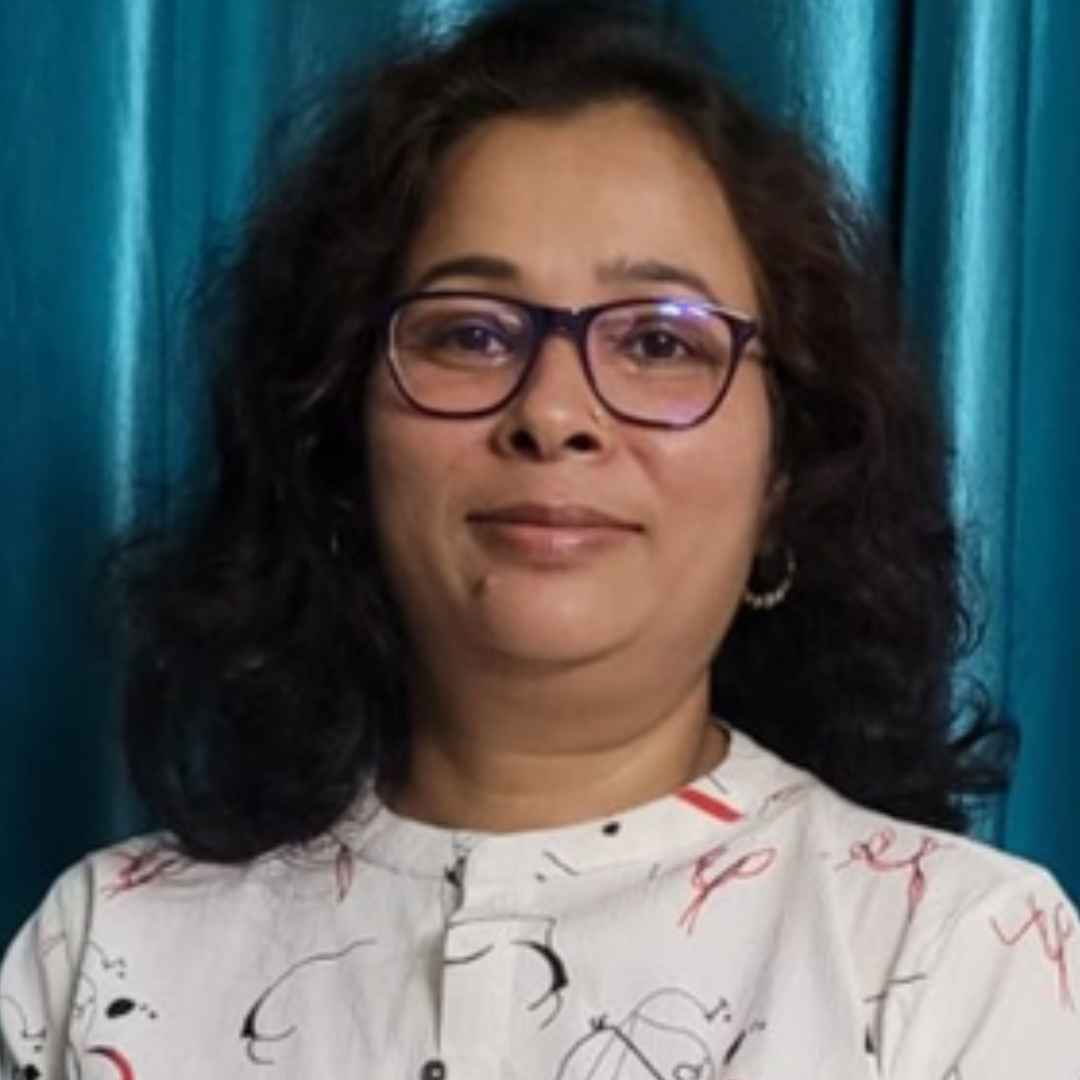
Meet Dr. Bharti
Learn clinical genomics from someone who has actually worked in clinical settings — with real patients, real diagnostic challenges, and real OMICS data..
👩🔬 Dr. Bharti occupies a rare professional position: she is simultaneously a clinical expert and a computational biologist — with direct experience handling clinicians, patients, and complex genomic data in real healthcare environments. Over her 18-year career, she has developed deep expertise in Molecular Genetics, Transplant Immunology, and Hemato-oncology, bringing a clinical depth to her bioinformatics teaching that no purely academic trainer can replicate.
Her hands-on clinical background spans CAR-T cell therapy, Mesenchymal stem cell therapy, DC & NK cell therapy, and histocompatibility typing — making her uniquely qualified to teach NGS applications in precisely the healthcare specialties this workshop covers. She has extensive practical experience with multiple OMICS platforms for clinical diagnostics and translational research, and builds strong professional networks between clinicians and computational biologists.
🧬 Molecular Genetics 🫀 Transplant Immunology 🩸 Hemato-oncology 💉 CAR-T Cell Therapy 🔬 OMICS Diagnostics 🧫 Histocompatibility Typing
18+ Years Experience
Clinical Patient-Facing Background
OMICS Multi-Platform Expert
90%+ Positive Feedback
Who Should Attend This Workshop?
This workshop is designed for anyone who works with or plans to work with RNA-Seq data, regardless of prior bioinformatics experience. That includes:
Students & Faculty: B.Sc./M.Sc./Ph.D. students in bioinformatics, genomics, and molecular biology; faculty incorporating RNA-Seq into research; biotechnology, genetics, biochemistry, and microbiology students.
Researchers & Scientists: Academic researchers generating RNA-Seq data; cancer biologists; plant and agricultural genomics scientists; drug discovery and pharmacogenomics researchers.
Clinical & Industry Professionals: Clinical researchers in precision medicine and oncology; biotech and pharma scientists in transcriptomics R&D; bioinformatics analysts; pathologists interested in transcriptomic diagnostics.
No prior transcriptomics or bioinformatics experience is required. The Galaxy Server platform makes both modules accessible to complete beginners while still delivering research-level skills to experienced participants.
Career Impact
How Does This Workshop Help My Career?
- Cancer Genomics & Translational Research — reference-based DGE, pathway, and network analysis are core skills for oncology research roles.
- Clinical Genomics & Precision Medicine — transcriptomic profiling is increasingly used in diagnostics and patient stratification.
- Pharmaceutical & Biotech R&D — drug target identification and biomarker discovery rely heavily on RNA-Seq data.
- Academic Research & PhD Applications — RNA-Seq is now standard methodology across biology and medicine; dual-workflow proficiency strengthens research proposals.
- Non-Model Organism & Agricultural Research — de novo transcriptomics is the only RNA-Seq approach available when no reference genome exists, making it essential for plant science, aquaculture, and ecology.
Why Choose Us
Why Choose BDG Lifesciences for Transcriptomics Training?
Since 2010, BDG Lifesciences has trained thousands of participants in RNA-Seq, transcriptomics, and bioinformatics — with a global reputation for practical, research-quality instruction.
✓ The Only 3-in-1 Transcriptomics Program- No other training provider combines De Novo, Reference-Based, and Meta-Transcriptomics in one structured program — making this the most comprehensive transcriptomics workshop available online.
✓ 16+ Years of Bioinformatics Training- Established in 2010, BDG Lifesciences has trained 50,000+ participants from 40+ countries with a consistent 4.7/5 rating — a proven track record of delivering research-quality skills.
✓ Government Registered & Internationally Authorized- MSME-registered under the Govt. of India and authorized to operate in Australia & NZ through BBR Group Pty Ltd. (ACN 608 550 849).
✓ Real Biological Datasets Across All 3 Modules- Every module uses real RNA-Seq and metatranscriptomic data — the same types of datasets published in peer-reviewed journals and used in clinical genomics settings.
✓ Galaxy Server Throughout — Accessible to All Levels- The Galaxy bioinformatics platform makes all three transcriptomics modules accessible to beginners while delivering research-grade analysis — no coding or command-line experience required.
✓ Verified Certificate Covering All 3 Modules- One comprehensive BDG Lifesciences certificate with a unique barcode — covering all three transcriptomics approaches. A uniquely valuable and verifiable credential for your portfolio.
Registration Fee
Simple, Transparent Pricing
One fee for all participants.
$99 US Dollars or ₹9090 Indian Rupees | No hidden charges. Includes live sessions, session recordings, and completion certificate.
Registration is non-refundable and non-transferable. Please read the full T&C below before registering.
FAQs
Frequently Asked Questions
What is the difference between reference-based and de novo RNA-Seq analysis? Reference-based analysis aligns sequencing reads to an existing, known genome and is used for well-studied organisms like humans or mice. De novo assembly builds a transcriptome from raw reads without any reference genome, which is necessary for novel or non-model species. This workshop teaches both.
Do I need prior bioinformatics or coding experience for this workshop? No. Both modules run on the Galaxy webserver, a browser-based platform that requires no command-line experience. The instructor guides all tool setup from Day 1.
How long is the RNA-Seq workshop and what is the schedule? The workshop runs 7 days, with live sessions of 60–90 minutes daily from 6:00–7:30 PM London time.
What software and tools will I use in this workshop? Galaxy webserver, FastQC, MultiQC, HISAT2, and FeatureCounts for reference-based analysis; Trinity, Kallisto/RSEM, Pfam, BLASTX, and BLASTP for de novo assembly; and DESeq2 for differential expression analysis in both modules.
Are the sessions recorded if I miss a day? Yes. All 7 sessions are recorded and shared via YouTube after each class. If you miss a session, you can complete the corresponding tasks by watching the recording.
Will I get a certificate after completing this workshop? Yes. On completing all practical tasks in both modules, you'll receive a BDG Lifesciences certificate with a unique barcode, sent by email.
How much does the workshop cost? $99 USD, the fee is the same for all participants within each category and covers live sessions, recordings, and the certificate.
Registration
How To Register
Secure your spot in 3 simple steps — seats are limited for each batch.
1️⃣ Click Register Now- Click the Register Now button and select number of tickets you want to buy..
2️⃣ Check Your Confirmation Email- After successful payment, check your email for a confirmation with registration details and next steps.
3️⃣ Receive Your Zoom Link- Once registration closes, you'll receive the Zoom meeting link and be added to the workshop WhatsApp group.
📧 Need help? Email us at workshops@bdglifesciences.com or chat with our AI Assistant George at bdglifesciences.com
T & C
- For this event the Fee is same for all participants which is $ 99 US equivalent to 9090 Indian Rupees.
- Please provide a GMAIL ID for registration as the recorded video session will be provided on YouTube. Kindly provide that email ID by which you use YouTube.
- Video recording of each session will be provided at the end of the session to give the user a unique learning experience.
- Interactive training sessions will be conducted on Google Meet/Zoom so to give users a better learning experience.
- As it is with a LIVE TRAINER hence practical application, i.e., the experiments/tasks to be performed can be done in the best explainable manner.
- In this Online Workshop, there will be a LIVE trainer who will solve queries along with training.
- The program is SELF-PACED. After each session video of that particular session will be shared with you so you can go through as many times as you want and perfect yourself in the topics & tasks.
- If you miss any session then NO PROBLEM you can still perform the tasks by going through the video of that particular session.
- Make sure you register under the right category. If you register under the wrong category then your registration will be invalid and NO REFUND WILL BE MADE IN THIS CASE. This is your mistake and the company is not responsible for it.
- To avoid this do read the description of the ticket before selecting and proceeding with payment.
- You need to upload your professional ID which can be your Student ID Card or Research Institute ID Card or Company ID Card. DO NOT UPLOAD EXPIRED ID OR ANY GOVERNMENT ID LIKE AADHAR, PAN, you have to upload professional ID.
- If you are currently not employed or not studying, you may upload the professional ID from your previous affiliation (degree or company), provided you are registering under the correct category. If you are in India, or will be in India at the time of the workshop or training or research project, your category will be Participants in India, and you can upload any valid ID (including one from your previous affiliation). If, at the time of the workshop or training or research project, you are not in India, your category will be Participants outside India, and you can upload any valid ID.
- After registration, you will join the workshop's WhatsApp group. If you have registered in the "Participants in India" category, you must join using an Indian phone number only.
- The certificate will be issued as per the details which you provide in the registration form while registering before payment.
- Once you register relax we will send you the meeting link after the workshop registration gets over.
- We want to make sure that you learn properly hence the training certificate will be given ONLY on successful completion of all the tasks given by the trainer.
- The certificates of all our Online programs are sent by email(softcopy) which has a unique barcode. You can take a print of that on heavy cardstock or photo paper and get it laminated if required.
- The registration is NON-REFUNDABLE and NON-TRANSFERABLE.
- BDG Lifesciences reserves the right of admission in all our programs.
- If you are removed or your registration is canceled then there will be no answer to that. We have our own reasons for such an act of ours
- If we do not wish to give this workshop to any participant then we will refund their amount.
- You should also read the Terms & Conditions page as well as the FAQs page. For any assistance kindly chat with our AI Assistant George on the website www.bdglifesciences.com.
BDG LifeSciences
BDG LifeSciences is a distinguished bioinformatics company established in 2010 and operates globally. Headquartered in India, the company specializes in facilitating workshops, training programs, novel and innovative research projects, and online courses in bioinformatics and life sciences. BDG LifeSciences is registered under the Ministry of MSME (Micro, Small, and Medium Enterprises), Government of India, with the registration number UDYAM-UP-01-0019151. In January 2024, BDG LifeSciences, India, has authorized BBR Group Pty Ltd., Australia (ACN 608 550 849), to operate its programs in Australia and New Zealand.
With a strong focus on the practical application of technology, BDG LifeSciences provides hands-on training where participants work on their own computers/laptops using specialized software and servers. The company has been a leader in this sector for the last 16 years, successfully educating a diverse range of participants, including students, scientists, faculty members, professors, and corporate executives worldwide.
Programs
Related Workshops
Company
- About Us
- Publications
- Advisors & Collaborators
- Blogs
- Careers
- FAQs
- Terms & Conditions
- Privacy Policy
- Contact Us
© 2026 BDG Lifesciences. All Rights Reserved. | 16+ Years of Bioinformatics Excellence | Trusted by 2,000+ Participants in 40+ Countries Privacy Policy · Terms & Conditions
Recommended Just for You