Overview
What is This MD Simulation Workshop?
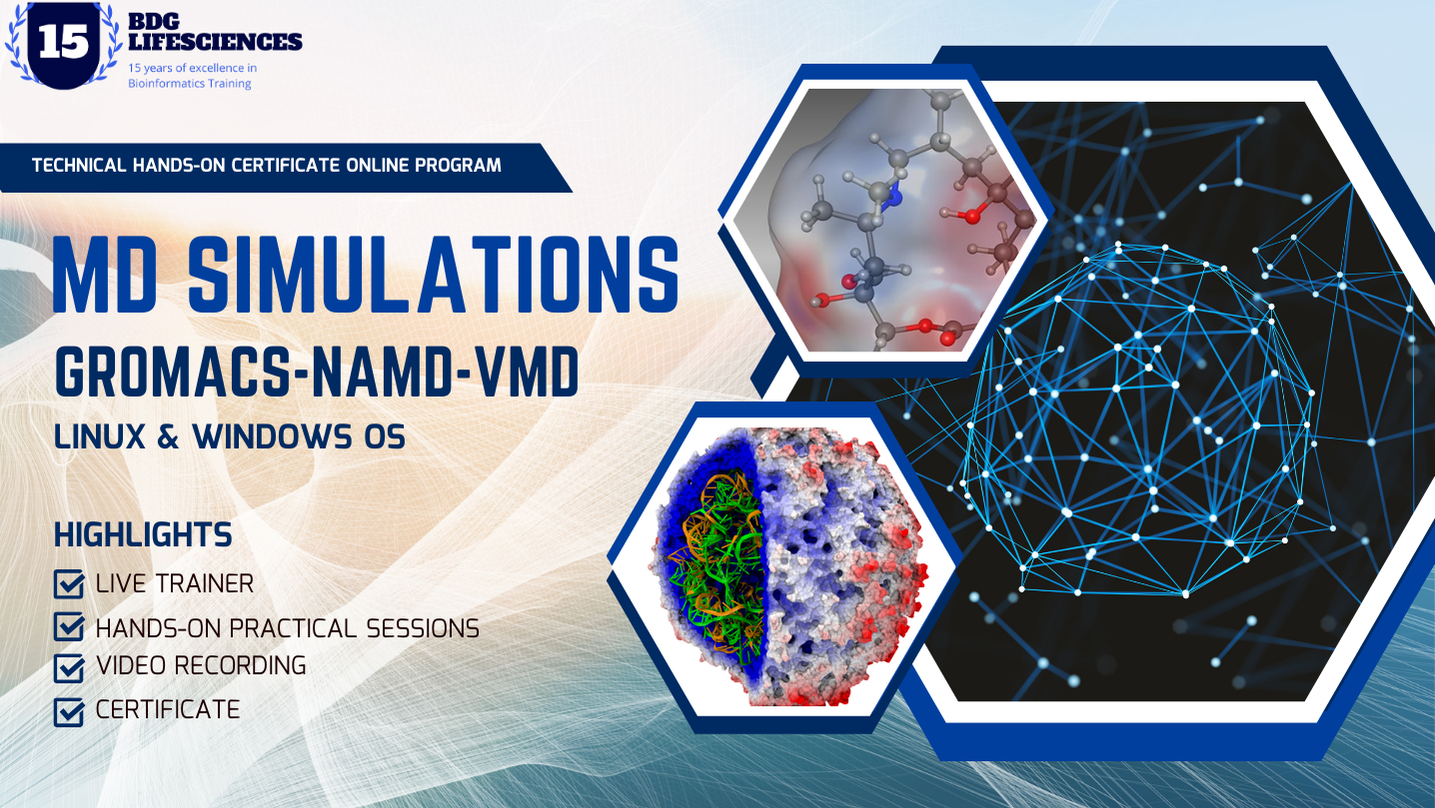
Molecular Dynamics (MD) simulations are a cornerstone of modern computational biophysics and drug discovery. This 10-Day Certificate Online Workshop provides comprehensive, hands-on training in MD simulations using GROMACS on Linux and NAMD/VMD on Windows — enabling participants to independently simulate protein-ligand interactions and analyze structural dynamics.
Each session is delivered live by expert trainer Sharvari Kulkarni (CTO, BDG Lifesciences) via Zoom, with session recordings provided for flexible revision. Participants work on their own computers, gaining real-world proficiency with production-grade bioinformatics tools.
Workshop Dates
21 to 30 May, 2026. Live trainer- Online sessions from 8:30 PM - 10 PM India time +5:30 GMT.
Learning Objectives
What You'll Learn in This MD Simulation Course
Upon completion of this molecular dynamics simulation workshop, participants will gain practical expertise applicable to drug discovery, structural biology, and computational biophysics research.
MD Simulation Principles- Understand the theory of molecular dynamics, force fields, time steps, and the physical basis of protein-ligand simulations in aqueous environments.
GROMACS Expertise- Gain full hands-on expertise with GROMACS to set up, run, and analyze protein-in-water and protein-ligand complex MD simulations on Linux.
NAMD & VMD on Windows- Set up NAMD simulations using PSF/PDB files, generate configuration files, and use VMD for molecular visualization and trajectory analysis.
RMSD & RMSF Analysis- Evaluate critical simulation metrics including Root Mean Square Deviation (RMSD), Root Mean Square Fluctuation (RMSF), and energy profiling for binding stability.
Protein-Ligand Simulation- Prepare topology files for both protein and ligand, build complex systems, run equilibration phases, and perform final MD production runs with analysis.
Visualization & Movie Making- Generate professional molecular simulation movies and visualizations using VMD, PyMOL, Chimera, and Discovery Studio for publication-ready output.
10-Day Curriculum
Complete Workshop Schedule — Day-by-Day Topics
A structured 10-day curriculum covering NAMD/VMD (Days 1–5) and GROMACS (Days 6–10), progressing from installation to full protein-ligand MD simulation analysis.
DAY 01- Theory + NAMD/VMD Installation
- MD Simulation theory and fundamentals
- Installation of NAMD on Windows
- Installation of VMD (Visual Molecular Dynamics)
- Installation of NAMD tutorial files
DAY 02- PDB/PSF File Generation
- Generation of PDB and PSF files via PGN scripting
- Meaning and description of molecular files
- File format understanding and preparation
DAY 03- Solvation Methods
- Protein solvation in water box
- Protein solvation in water sphere
- Periodic boundary conditions
DAY 04- Running NAMD Simulation
- Preparation of NAMD configuration files
- Running the full MD simulation
- Monitoring simulation progress
DAY 05- NAMD-VMD Analysis + Software Setup
- Analysis of NAMD-VMD simulation output
- VirtualBox installation for Linux
- QTGRACE, Discovery Studio, Chimera setup
DAY 06- GROMACS: Protein-in-Water Setup
- GROMACS installation on Linux
- Running protein in water simulation
- Topology preparation and solvation
DAY 07- Ionization, Minimization & Equilibration
- Ionization of the simulation system
- Energy minimization protocols
- Equilibration Phase I & II with analysis
DAY 08- Protein-Ligand Complex Simulation
- Protein topology preparation with GROMACS
- Ligand topology preparation (CHARMM/GAFF)
- Building the complex and topology file
DAY 09- Complex Preparation — Minimization
- Solvation of protein-ligand complex
- Ionization of the complex system
- Energy minimization of complex
DAY 10- Final MD Run + Analysis + Movie Making
- Making index files for GROMACS
- Equilibration Phase I & II
- Final MD production run
- RMSD/RMSF analysis and movie making
Training Methodology
How This MD Simulation Training is Conducted
A carefully designed blend of theory, practical demonstrations, and hands-on execution ensures participants gain both conceptual understanding and real-world proficiency.
🧠 Step 01- Introduction to MD Simulations- Overview of molecular dynamics theory, force fields (CHARMM, AMBER, GROMOS), and the significance of simulating protein-ligand interactions in computational drug discovery.
🛠️ Step 02- Software Setup & Environment- Guided installation of GROMACS (Linux via VirtualBox), NAMD, VMD, PyMOL, Discovery Studio, and QTGRACE. Participants work directly on their own laptops/desktops.
📁 Step 03- Input Preparation- Practical training on downloading protein structures from PDB, preparing ligand topologies, docking-based complex preparation, and parameter file generation.
▶️ Step 04- Simulation Execution- Step-by-step instructions for setting up, running, and troubleshooting protein-in-water and protein-ligand complex MD simulations using GROMACS and NAMD.
📈 Step 05- Post-Simulation Analysis- Analyze RMSD, RMSF, energy profiles, radius of gyration, and hydrogen bonds using GROMACS tools, QTGRACE, VMD, and Discovery Studio for comprehensive insights.
🔬 Step 06- Real-World Case Study- Apply all learned skills to simulate an actual protein-ligand interaction. Universal GROMACS analysis codes are provided for reuse in participants' own research projects.
What You Will Achieve
Learning Outcomes After This Workshop
Upon successful completion of this 10-day hands-on certificate workshop, participants will be able to:
Molecular Dynamics Simulation Skills
- Independently set up, run, and troubleshoot full MD simulations using GROMACS on Linux and NAMD on Windows
- Prepare protein and ligand topology files, define force fields, and build simulation-ready systems from scratch
- Perform energy minimization, equilibration (Phase I & II), and production MD runs for protein-ligand complexes
- Solvate molecular systems in water boxes and water spheres, and perform ionization of simulation environments
- Generate PDB and PSF files using PGN scripting for NAMD-based simulations
Analysis & Interpretation Skills
- Calculate and interpret RMSD (Root Mean Square Deviation) to assess simulation stability and ligand binding consistency
- Analyse RMSF (Root Mean Square Fluctuation) to identify flexible and rigid regions of the protein structure
- Perform energy profiling to evaluate thermodynamic stability of protein-ligand complexes
- Create index files and run post-simulation analysis workflows using GROMACS built-in tools
- Visualize and interpret trajectory data using VMD, PyMOL, Chimera, and Discovery Studio
Visualization & Reporting Skills
- Generate publication-quality molecular visualization images of protein-ligand complexes
- Create simulation trajectory movies using VMD for presentations and research reports
- Plot RMSD, RMSF, and energy graphs using QTGRACE for research-ready figures
- Apply universal GROMACS analysis codes to your own research projects independently
Applied Research Competencies
- Simulate real protein-ligand interactions and determine the most stable binding conformations
- Apply MD simulation methodology to drug discovery, structural biology, and computational biophysics research
- Confidently troubleshoot common errors encountered during GROMACS and NAMD simulation runs
- Design and execute an end-to-end MD simulation pipeline — from raw PDB input to final analysed trajectory
Your Instructor
Meet Your Expert Trainer
Learn from one of India's foremost bioinformatics experts — directly, live, and interactively.
👩🔬 Sharvari Kulkarni | CTO, BDG Lifesciences | Bioinformatics & Computational Drug Design Expert
Sharvari Kulkarni is a leading expert in Bioinformatics, specializing in Drug Design, Molecular Simulations, Dynamics, and Network Pharmacology. As CTO and core member of the technical team at BDG Lifesciences, she has trained thousands of participants across the globe, consistently receiving over 90% positive feedback for her structured lesson plans, patient teaching style, and deep subject mastery.
Her expertise spans computer-aided drug design, molecular docking on both Windows and Linux platforms, and MD simulations using Schrödinger's Desmond Maestro and GROMACS. With over 15 research papers published in reputable peer-reviewed journals, she also guides student research projects and serves on international academic and industry panels — including as a speaker on global computational biology platforms.
15+ Research Papers Published | 90%+ Positive Feedback Rate | 1,000+ Participants Trained | Global International Speaker
Who Should Attend
This MD Simulation Workshop is Designed For
From life sciences students to experienced computational biologists and drug discovery professionals — this program delivers complete, hands-on GROMACS and NAMD proficiency across all experience levels.
🎓 Students & Faculty
- B.Sc., M.Sc. & Ph.D. students in Bioinformatics, Biochemistry, Microbiology, Genetics, and Life Sciences
- MBBS and MD students seeking computational biology and drug discovery skills
- Researchers performing protein-ligand studies in academic and institutional labs
- Faculty members in Biotechnology, Molecular Biology, and Pharmaceutical Sciences
- Plant Science, Biomedical Technology, and Immunology students entering computational research
🏭 Industry & Bioinformatics Professionals
- Computational biologists and bioinformatics analysts in biotech and pharma R&D
- Drug discovery scientists seeking to validate docking results with MD simulation evidence
- Molecular modelling and structure-based drug design professionals
- NGS and wet lab scientists looking to add computational simulation skills to their profile
- Data scientists and researchers entering the field of computational biophysics
🏥 Research & Clinical Professionals
- Structural biologists studying protein folding, conformational dynamics, and biomolecular interactions
- Pharmacologists and medicinal chemists analysing drug-target binding stability
- Cancer and disease researchers using computational tools for therapeutic target validation
- Clinician-researchers in precision medicine integrating computational approaches into translational work
- Professionals in genomics, proteomics, and multi-omics research expanding into structural simulation
No prior MD simulation, Linux, or coding experience is required. This workshop is structured for all skill levels — from complete beginners with no command-line background to intermediate researchers who want to formalise their GROMACS and NAMD skills with a structured, certificate-backed, hands-on training program.
Career Impact
How This MD Simulation Workshop Advances Your Career
MD simulation expertise is rapidly becoming a non-negotiable skill in computational biology, drug discovery, and structural biophysics research. Here is how this certification directly benefits your specific career path.
- Computational Drug Discovery & Pharmaceutical R&D Protein-ligand MD simulations are now a standard validation step in structure-based drug design pipelines. Researchers who can independently set up, run, and analyze MD simulations using GROMACS are in high demand across pharma R&D, biotech startups, and CROs — where computational screening and binding stability analysis directly influence candidate selection decisions.
- PhD Research & Academic Publications Demonstrable MD simulation skills — particularly GROMACS-based protein-ligand complex analysis with RMSD, RMSF, and energy profiling — significantly strengthen PhD applications, research fellowship proposals, and the technical depth of academic publications. Reviewers and supervisors increasingly expect computational validation of molecular interactions.
- Structural Biology & Protein Engineering Understanding how proteins flex, fold, and interact with ligands at the atomic level is central to structural biology. MD simulation skills allow researchers to study conformational changes, protein stability, and the dynamic behaviour of engineered biomolecules — capabilities that are increasingly expected in structural biology and protein design labs worldwide.
- Bioinformatics & Computational Biology Roles As computational biology becomes a core function in research institutions, hospitals, and biotech companies, proficiency in molecular dynamics tools — GROMACS, NAMD, VMD — directly expands your employability. This certificate demonstrates practical, tool-level expertise that goes beyond theoretical knowledge and is immediately applicable on the job.
- Biotechnology & Biomolecule Development MD simulations are widely used in biotechnology for developing and optimising therapeutic proteins, antibodies, and enzymes. Professionals with GROMACS and NAMD experience can contribute directly to biomolecule stability studies, formulation research, and the characterisation of industrial-use proteins — a growing area in biologics development.
- Genetic Research & Mutation Impact Studies MD simulations are a powerful method for studying how genetic mutations affect protein structure, stability, and function at the molecular level. Researchers in genetics, genomics, and personalised medicine increasingly use MD simulations to predict the structural consequences of single-nucleotide variants and disease-associated mutations.
Why Choose Us
Why Choose BDG Lifesciences for this MD SimulationTraining?
Since 2010, BDG Lifesciences has delivered hands-on, practical bioinformatics and computational biology training to participants across 50+ countries — with a consistent 4.7/5 participant rating and over 90% positive feedback across all programs.
✓ The Only Trainer Offering Hands-on Protein-Ligand MD Simulation Training Sharvari Kulkarni is the only trainer at BDG Lifesciences — and one of very few online instructors globally — who conducts live, hands-on MD simulation training specifically for protein-ligand complexes using GROMACS. Participants receive universal reusable analysis codes, practical case studies, and direct troubleshooting support that no pre-recorded course can replicate.
✓ Both GROMACS and NAMD Covered in a Single Program Most MD simulation courses cover one tool on one operating system. This workshop covers GROMACS on Linux and NAMD & VMD on Windows — in a single 10-day program — giving participants versatility across the two most widely used MD simulation environments in academic and industry research settings worldwide.
✓ Real Protein-Ligand Case Studies Throughout All simulations are performed on real biological systems — not simplified toy examples. Participants work with actual protein-ligand complexes, using the same GROMACS workflows employed in published drug discovery and computational biophysics research.
✓ Live Expert Training with Session Recordings Live sessions with Sharvari Kulkarni ensure real-time guidance, immediate troubleshooting, and interactive Q&A at every step. Session recordings shared after each class ensure no analysis step is ever missed — the most effective format for learning complex MD simulation workflows that involve multi-step command execution.
✓ Verified Certificate with Unique Barcode A BDG Lifesciences Certificate of Completion covering GROMACS, NAMD, VMD, protein-ligand simulation, and computational biophysics — carrying a unique barcode for independent verification. A credible, globally recognised credential for academic profiles, LinkedIn, and professional portfolios.
✓ Government Registered & Internationally Authorised MSME-registered under the Government of India (UDYAM-UP-01-0019151) and officially authorised to operate in Australia and New Zealand via BBR Group Pty Ltd (ACN 608 550 849) — giving participants the assurance of a formally recognised, internationally operating training institution.
Registration Fee
Simple, Transparent Pricing
One fee for all participants. No hidden charges. Includes live sessions, session recordings, and completion certificate.
Participants in India
₹ 9307 Indian Rupees — same for all Indian participants | Register Now →
Global (Participants Outside India)
$ 99 US Dollars — same for all international participants | Register Now →
Registration is non-refundable and non-transferable. Please read the full T&C below before registering.
FAQs
Frequently Asked Questions
Everything you need to know before registering for this MD Simulation & Computational Biophysics workshop using GROMACS, NAMD & VMD.
Do I need prior coding or bioinformatics experience to attend this MD simulation workshop? No prior coding, Linux, or bioinformatics experience is required. The workshop is designed to build your skills from scratch. On Day 1, the trainer starts with theory and guides you step-by-step through every installation and command. Participants work on their own computers with the trainer demonstrating each step live on Zoom — making this accessible to complete beginners as well as intermediate-level researchers who want to formalise their MD simulation skills with a structured, certificate-backed program.
What is the difference between GROMACS and NAMD, and will I learn both? Yes, you will learn both tools in this single workshop. GROMACS is a powerful, high-performance MD simulation package used primarily on Linux — covered in Days 6–10, including protein-in-water simulation, protein-ligand complex simulation, equilibration, and RMSD/RMSF analysis. NAMD (Nanoscale Molecular Dynamics) is a widely used MD engine for Windows — covered in Days 1–5 alongside VMD for molecular visualization and trajectory analysis. Learning both tools gives you versatility across different research environments and operating systems, making you a stronger candidate for computational biology positions worldwide.
What computer or operating system do I need for this MD simulation course? You need a Windows 10 computer with an Intel i3 processor or above and a stable internet connection for Zoom. For GROMACS (Linux-based simulations on Days 6–10), participants install VirtualBox on their Windows machine — the trainer walks through this installation live on Day 5. No separate Linux computer is required. NAMD and VMD sessions (Days 1–5) run natively on Windows. A minimum of 8 GB RAM is recommended for smooth performance during simulation runs.
Are sessions recorded? What if I miss a day of the workshop? Yes — every session is recorded and shared with all participants after class ends each day via YouTube, using the Gmail ID you provide during registration. The program is fully self-paced for revision. If you miss a session, you can complete all tasks by watching the recording at your own pace. This flexibility is built into the program design. Please ensure you register with the Gmail ID you actively use on YouTube so that access is seamless.
Will I receive a certificate after completing this GROMACS and MD simulation workshop? Yes. Upon successful completion of all tasks assigned by the trainer across all 10 days, you will receive a BDG Lifesciences Certificate of Completion via email. The certificate is a digital softcopy carrying a unique barcode for independent verification — it can be printed on heavy cardstock or photo paper, laminated, shared on LinkedIn, or added to your academic and professional portfolio. The certificate is issued exactly as per the name and details you provide during registration — please fill these carefully as corrections are not possible after issuance.
What specific topics and tools are covered in the GROMACS portion of this workshop? The GROMACS section (Days 6–10) covers: GROMACS installation on Linux via VirtualBox; protein-in-water simulation setup and topology preparation; solvation, ionization, and energy minimization; equilibration Phase I and II; protein-ligand complex simulation including protein and ligand topology preparation, complex file and topology file creation; final MD production run; making index files; and comprehensive post-simulation analysis including RMSD, RMSF, energy profiling, and molecular movie making using VMD. Universal reusable GROMACS analysis codes are provided to participants for use in their own research projects.
What does RMSD and RMSF analysis tell us in a molecular dynamics simulation? RMSD (Root Mean Square Deviation) measures how much a protein's structure deviates from its initial conformation over the course of the simulation trajectory — used to assess whether the protein-ligand complex has reached equilibrium and to evaluate the stability of ligand binding. RMSF (Root Mean Square Fluctuation) measures the mobility or flexibility of individual amino acid residues throughout the simulation — identifying rigid and highly dynamic regions of the protein. Both metrics are core outputs of MD simulation analysis, are computed using GROMACS tools, and are visualized using QTGRACE — covered in full on Day 10 of this workshop.
Is this MD simulation workshop suitable for drug discovery researchers and pharmaceutical scientists? Absolutely. This workshop is directly relevant to professionals in drug discovery, computational drug design, and pharmaceutical R&D. Protein-ligand MD simulations are a critical methodology for validating molecular docking results, studying binding stability, exploring conformational dynamics of drug-target complexes, and ranking drug candidates by binding free energy. Participants will simulate real protein-ligand complexes and analyze binding using RMSD, RMSF, and energy profiling — skills directly applicable to structure-based drug design pipelines used in academia and industry.
What is the registration fee and how do I register for this MD simulation course? The registration fee is $99 USD for international participants and ₹9307 Indian Rupees for participants in India — the same fee applies for all participants within each category with no hidden charges. To register: click the Register Now button, select your correct participant category, upload your professional ID (student, institute, or company ID — not expired, not a government ID), and complete the payment. After payment, you will receive a confirmation email with next steps. The Zoom meeting link will be sent once registration closes. For queries, email info@bdglifesciences.com or talk to our AI Agent George on bdglifesciences.com.
What is a force field in MD simulations and is this covered in the course? A force field is a mathematical framework that describes how atoms in a molecular system interact — defining parameters for bond stretching, angle bending, torsional rotation, and non-bonded electrostatic and van der Waals interactions. Common force fields include CHARMM, AMBER, GROMOS, and OPLS. In this workshop, force field selection, protein topology preparation, and ligand topology generation are covered in detail as part of the GROMACS protein-ligand complex simulation workflow on Days 8–10 — forming the foundation for generating accurate and reproducible MD simulations.
Can I use the GROMACS scripts and analysis codes from this workshop in my own research? Yes — this is one of the standout practical benefits of this workshop. Participants receive universal GROMACS analysis codes specifically designed to be reusable and adaptable to your own biological systems. These are not locked to the training case study — you can apply them directly to your PhD research, laboratory projects, or industry workflows. The trainer ensures you understand the logic behind each command so you can confidently modify and extend the scripts for different protein-ligand systems, force fields, or simulation parameters.
Who is the trainer for this workshop and what are their qualifications? The workshop is conducted by Sharvari Kulkarni, CTO of BDG Lifesciences and a leading expert in Bioinformatics, Drug Design, Molecular Simulations, Dynamics, and Network Pharmacology. She is the only trainer at BDG Lifesciences conducting hands-on MD simulation training for protein-ligand complexes, and has trained hundreds of participants globally with over 90% positive feedback. With 15+ research papers published in reputable journals, she also guides student research projects and contributes to curriculum development as a speaker on international computational biology platforms. She is highly proficient in GROMACS, NAMD, VMD, and Schrödinger's Desmond Maestro.
Registration
How To Register
Secure your spot in 3 simple steps — seats are limited for each batch.
1️⃣ Click Register Now- Click the Register Now button and select number of tickets you want to buy..
2️⃣ Check Your Confirmation Email- After successful payment, check your email for a confirmation with registration details and next steps.
3️⃣ Receive Your Zoom Link- Once registration closes, you'll receive the Zoom meeting link and be added to the workshop WhatsApp group.
📧 Need help? Email us at workshops@bdglifesciences.com or chat with our AI Assistant George at bdglifesciences.com
T & C
- For this event the Fee is same for all participants which is $ 99 US equivalent to 9307 Indian Rupees.
- Please provide a GMAIL ID for registration as the recorded video session will be provided on YouTube. Kindly provide that email ID by which you use YouTube.
- Video recording of each session will be provided at the end of the session to give the user a unique learning experience.
- Interactive training sessions will be conducted on Google Meet/Zoom so to give users a better learning experience.
- As it is with a LIVE TRAINER hence practical application, i.e., the experiments/tasks to be performed can be done in the best explainable manner.
- In this Online Workshop, there will be a LIVE trainer who will solve queries along with training.
- The program is SELF-PACED. After each session video of that particular session will be shared with you so you can go through as many times as you want and perfect yourself in the topics & tasks.
- If you miss any session then NO PROBLEM you can still perform the tasks by going through the video of that particular session.
- Make sure you register under the right category. If you register under the wrong category then your registration will be invalid and NO REFUND WILL BE MADE IN THIS CASE. This is your mistake and the company is not responsible for it.
- To avoid this do read the description of the ticket before selecting and proceeding with payment.
- You need to upload your professional ID which can be your Student ID Card or Research Institute ID Card or Company ID Card. DO NOT UPLOAD EXPIRED ID OR ANY GOVERNMENT ID LIKE AADHAR, PAN, you have to upload professional ID.
- If you are currently not employed or not studying, you may upload the professional ID from your previous affiliation (degree or company), provided you are registering under the correct category. If you are in India, or will be in India at the time of the workshop or training or research project, your category will be Participants in India, and you can upload any valid ID (including one from your previous affiliation). If, at the time of the workshop or training or research project, you are not in India, your category will be Participants outside India, and you can upload any valid ID.
- After registration, you will join the workshop's WhatsApp group. If you have registered in the "Participants in India" category, you must join using an Indian phone number only.
- The certificate will be issued as per the details which you provide in the registration form while registering before payment.
- Once you register relax we will send you the meeting link after the workshop registration gets over.
- We want to make sure that you learn properly hence the training certificate will be given ONLY on successful completion of all the tasks given by the trainer.
- The certificates of all our Online programs are sent by email(softcopy) which has a unique barcode. You can take a print of that on heavy cardstock or photo paper and get it laminated if required.
- The registration is NON-REFUNDABLE and NON-TRANSFERABLE.
- BDG Lifesciences reserves the right of admission in all our programs.
- If you are removed or your registration is canceled then there will be no answer to that. We have our own reasons for such an act of ours
- If we do not wish to give this workshop to any participant then we will refund their amount.
- You should also read the Terms & Conditions page as well as the FAQs page. For any assistance kindly chat with our AI Assistant George on the website www.bdglifesciences.com.
BDG LifeSciences
BDG LifeSciences is a distinguished bioinformatics company established in 2010 and operates globally. Headquartered in India, the company specializes in facilitating workshops, training programs, novel and innovative research projects, and online courses in bioinformatics and life sciences. BDG LifeSciences is registered under the Ministry of MSME (Micro, Small, and Medium Enterprises), Government of India, with the registration number UDYAM-UP-01-0019151. In January 2024, BDG LifeSciences, India, has authorized BBR Group Pty Ltd., Australia (ACN 608 550 849), to operate its programs in Australia and New Zealand.
With a strong focus on the practical application of technology, BDG LifeSciences provides hands-on training where participants work on their own computers/laptops using specialized software and servers. The company has been a leader in this sector for the last 16 years, successfully educating a diverse range of participants, including students, scientists, faculty members, professors, and corporate executives worldwide.
Programs
Related Workshops
Company
© 2026 BDG Lifesciences. All Rights Reserved. | 16+ Years of Bioinformatics Excellence | Trusted by 2,000+ Participants in 40+ Countries Privacy Policy · Terms & Conditions