More
GROMACS and MM-PBSA Molecular Dynamics Simulation Workshop of 4 Days
Learn the computational workflow for protein–ligand complex preparation, molecular dynamics simulation, trajectory analysis and MM-PBSA.
4.7

This Event Includes
- High demand video
- Learn from Experts
- Hands-on practical sessions
- Certificate on completion
Registration Fee |
|
In US $ |
$ 99 |
In Indian Rupees |
₹ 9250 |
4Days |
1.5 hrsPer day |
MM-PBSAKey focus, Days 3–4 |
GROMACSProtein–ligand MD simulation |
4-Day GROMACS and MM-PBSA Workshop: Molecular Dynamics Simulation of Protein–Ligand Complexes
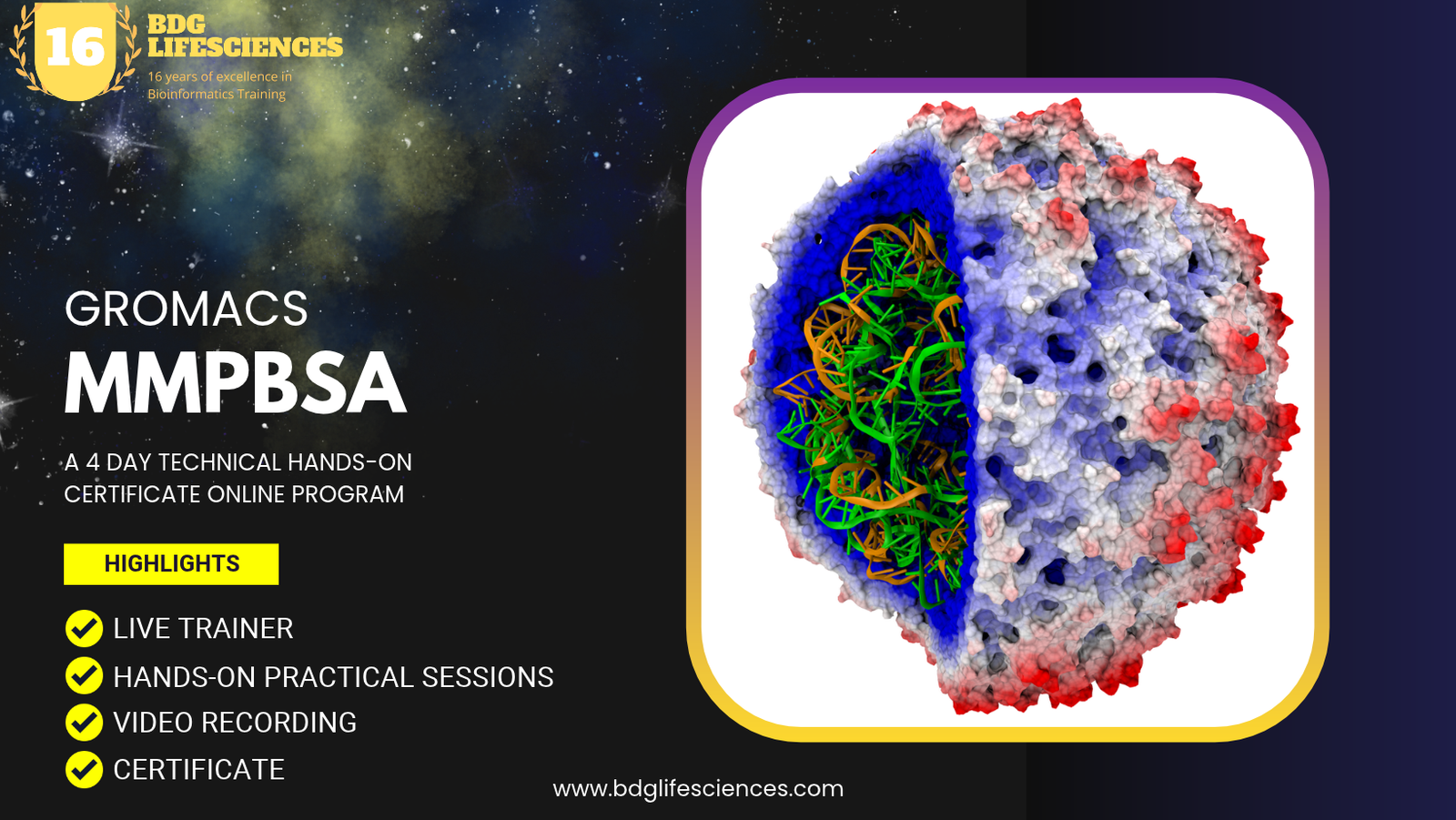
The 4-Day GROMACS and MM-PBSA Workshop by BDG Lifesciences teaches the computational workflow for molecular dynamics (MD) simulation of protein–ligand complexes using GROMACS, and builds towards MM-PBSA (Molecular Mechanics Poisson–Boltzmann Surface Area): its importance, environment creation, execution and graph analysis using Python scripts and a graphical user interface (GUI) analyzer.
Molecular dynamics simulation is an important computational approach used to investigate the structural behaviour and dynamic interactions of biological molecules. In computational drug discovery and molecular modelling, MD simulations help researchers study how protein–ligand complexes behave over time under defined simulation conditions.
The programme uses GROMACS, a molecular dynamics simulation software package, to cover VirtualBox and GROMACS installation, protein and ligand topology preparation, complex GRO file preparation and topology editing. It then progresses through solvation, ionization, minimization, NVT and NPT equilibration and the final production MD run, followed by trajectory analysis using GROMACS codes, including trajectory movie making. The final part focuses on MM-PBSA.
This GROMACS training programme provides an introduction to the computational workflow connecting protein–ligand complex preparation, molecular dynamics simulation and MM-PBSA-based analysis, making it relevant to researchers and students interested in computational biology, structural bioinformatics and computational drug discovery.
Workshop Dates
21 to 24 December, 2026. Live trainer- Online sessions from 8:30 PM - 10 PM India time +5:30 GMT.
Workshop Quick Facts
|
Workshop |
4-Day GROMACS and MM-PBSA Workshop by BDG Lifesciences |
|
|
Duration |
4 days, 1.5 hours per day |
|
|
Key focus |
MM-PBSA (Molecular Mechanics Poisson–Boltzmann Surface Area): importance, environment creation, execution and graph analysis |
|
|
Software |
GROMACS on VirtualBox; Python scripts and a GUI analyzer for graph analysis |
|
|
Workflow |
Protein–ligand complex preparation, molecular dynamics simulation, trajectory analysis, then MM-PBSA |
What Is MM-PBSA and Why Is It the Key Part of This Workshop?
|
MM-PBSA stands for Molecular Mechanics Poisson–Boltzmann Surface Area. It is a computational approach used to estimate binding free-energy-related quantities from molecular mechanics and continuum-solvent contributions. It provides an additional computational perspective for investigating protein–ligand interactions. |
MM-PBSA is the final and central component of the workshop. Day 3 introduces the importance of MM-PBSA and MM-PBSA environment creation, and Day 4 covers running the MM-PBSA and analysing the resulting graphs with Python scripts and a GUI analyzer. The MM-PBSA environment preparation provides the computational setup required for this stage.
How MM-PBSA Is Covered in the Workshop
|
1. Importance of MM-PBSA (Day 3) |
2. MM-PBSA environment creation (Day 3) |
|
|
3. Running the MM-PBSA (Day 4) |
4. Graph analysis (Day 4) |
|
GROMACS and MM-PBSA Workshop Learning Pathway
|
Day 1 |
→ |
Day 2 |
→ |
Day 3 |
→ |
Day 4 |
Warm colours (Days 3 and 4) mark where MM-PBSA is covered.
Day-by-Day Schedule: GROMACS Simulation to MM-PBSA Analysis
Day 1 — Molecular Dynamics Simulation of Protein–Ligand Complexes Using GROMACS on VirtualBox
|
The first day introduces the computational environment required for MD simulation, followed by the preparation of the protein–ligand complex. The focus is on understanding the environment and the preparation of the molecular system before proceeding with simulation.
|
1.5hours |
Day 2 — Molecular Dynamics Simulation Preparation and Execution
|
Before a production MD run can be performed, the molecular system must undergo several preparation and equilibration steps. These stages introduce the sequence of operations involved in preparing and running a protein–ligand MD simulation using GROMACS.
|
1.5hours |
Day 3 — GROMACS Analysis and MM-PBSA Preparation
|
The third day moves from MD simulation towards post-simulation analysis and MM-PBSA preparation. Participants are introduced to the importance of examining MD trajectories and the role of MM-PBSA in computational studies of protein–ligand interactions.
|
1.5hours |
Day 4 — MM-PBSA Execution and Analysis
|
The final day focuses on MM-PBSA execution and the interpretation of the resulting graphs. This stage introduces the computational workflow associated with MM-PBSA execution and the use of Python scripts and graphical analysis interfaces to examine the resulting graphs.
|
1.5hours |
Workshop at a Glance: How Much of the Workshop Is MM-PBSA?
MM-PBSA topics appear on both Day 3 and Day 4, the second half of the workshop. The schedule lists 19 topics: 6 on protein–ligand system preparation (Day 1), 7 on MD simulation (Day 2), 2 on GROMACS trajectory analysis (Day 3) and 4 on MM-PBSA (importance, environment creation, running the MM-PBSA and graph analysis).
 |
|
||||||||||||||||
MM-PBSA Topics on Each Day
|
Other topics |
MM-PBSA topics |
|
Day 1 |
|
0 of 6 topics on MM-PBSA |
||
|
Day 2 |
|
0 of 7 topics on MM-PBSA |
||
|
Day 3 |
|
2 of 4 topics on MM-PBSA |
||
|
Day 4 |
|
2 of 2 topics on MM-PBSA |
How the Workshop Works: Five-Stage GROMACS to MM-PBSA Workflow
The workshop follows a sequential computational workflow connecting molecular system preparation, molecular dynamics simulation, trajectory analysis and MM-PBSA analysis. Each stage contributes to the overall process of investigating protein–ligand complexes using computational methods.
|
Stage 1: Software Environment and System Preparation |
VirtualBox provides a virtualisation environment in which a separate operating system can be run within an existing computer system. GROMACS is then installed as the molecular dynamics simulation software used in the programme. |
|
|
Stage 2: Protein–Ligand Complex Preparation |
The protein and ligand must be represented in a format suitable for the simulation software. Protein topology, ligand topology, the complex GRO file and topology file editing establish the molecular system that will undergo simulation. |
|
|
Stage 3: Molecular Dynamics Simulation |
Solvation, ionization, energy minimization, index files, NVT and NPT equilibration and the final production MD run, from which the trajectories for analysis are obtained. |
|
|
Stage 4: Molecular Dynamics Trajectory Analysis |
Analysis using GROMACS codes and trajectory movie making. A simulation produces a time-dependent representation of the molecular system rather than a single static structure. |
|
|
Stage 5: MM-PBSA Analysis |
The final stage introduces MM-PBSA and its relevance to computational studies of protein–ligand interactions: understanding its importance, MM-PBSA environment creation, running the MM-PBSA and analysis of graphs using Python scripts and a GUI analyzer. The environment preparation provides the computational setup for this stage, and the resulting graphs are examined with the specified Python script and graphical analysis interface. |
Who Should Attend the GROMACS and MM-PBSA Workshop?
The workshop is relevant to individuals interested in molecular dynamics simulation, protein–ligand interactions and computational approaches used in drug discovery research. It may be particularly useful for:
|
Undergraduate students in Life Sciences and Biotechnology |
Students interested in computational biology, molecular modelling and structural bioinformatics can gain an introduction to the workflow involved in MD simulation and protein–ligand complex analysis. |
|
|
Postgraduate students |
MSc and MTech students working in biotechnology, bioinformatics, computational biology, pharmaceutical sciences and related disciplines. |
|
|
PhD scholars and research students |
Researchers working on protein–ligand interactions, structural biology, molecular modelling and computational drug discovery can explore the GROMACS simulation workflow and the role of MM-PBSA in their research areas. |
|
|
Computational Biology and Bioinformatics Researchers |
Researchers interested in expanding their understanding of molecular simulation workflows, including topology preparation, simulation execution and trajectory analysis. |
|
|
Molecular Modelling and Computational Drug Discovery Professionals |
Professionals involved in computational studies of molecular interactions who want to understand the relationship between MD simulations and MM-PBSA-based analysis. |
|
|
Structural Biology Researchers |
Researchers studying protein structures and molecular interactions can explore how MD simulation provides a time-dependent perspective on protein–ligand complexes. |
What You Will Learn: MM-PBSA and the GROMACS Workflow
Understanding molecular dynamics simulation requires familiarity with the different computational stages involved in preparing, running and analysing a molecular system. The learning benefits are directly connected to the four-day curriculum, with MM-PBSA at its centre.
|
Understand the importance of MM-PBSA |
Learn about the role of MM-PBSA in computational studies involving protein–ligand interactions. |
|
|
MM-PBSA environment creation and execution |
Explore MM-PBSA environment preparation and become familiar with MM-PBSA execution. |
|
|
Graph analysis with Python and a GUI analyzer |
Understand the role of Python scripts in analysing graphs, explore the use of a GUI analyzer and become familiar with interpreting graphical outputs generated through the MM-PBSA workflow. |
|
|
The GROMACS computational environment |
Understand the role of VirtualBox, become familiar with GROMACS installation and understand the software environment required for MD simulation. |
|
|
Protein–ligand complex preparation |
Understand protein topology preparation, ligand topology preparation, complex GRO file preparation and the importance of topology file editing. |
|
|
MD simulation preparation and production |
Understand solvation, ionization, energy minimization, index files and NVT and NPT equilibration, and the transition from equilibration to production MD. |
|
|
Trajectory analysis |
Explore GROMACS-based trajectory analysis, understand the purpose of trajectory movie making and recognise the importance of examining simulation trajectories. |
The programme is intended to provide familiarity with the workflow and its computational components.
How MM-PBSA and GROMACS Training Can Help Your Career
Molecular dynamics simulation and MM-PBSA analysis are relevant computational approaches in several areas of molecular research and drug discovery. Understanding the workflow covered in this programme can help participants develop a stronger foundation for working with computational studies involving protein–ligand complexes.
|
Computational Drug Discovery |
Understanding GROMACS and MM-PBSA workflows can be relevant to researchers investigating protein–ligand interactions as part of computational drug discovery studies. |
|
|
Molecular Modelling and Structural Bioinformatics |
The programme introduces protein–ligand complex preparation, topology preparation, MD simulation and MD trajectories, providing context for computational analysis of molecular systems and biological structures. |
|
|
Protein–Ligand Interaction Studies |
The workshop introduces the relationship between MD simulation and MM-PBSA, two computational components relevant to investigating protein–ligand systems. |
|
|
Academic and Doctoral Research |
For postgraduate students and PhD scholars, familiarity with the workflow may help when planning or participating in research projects involving MD simulation and MM-PBSA analysis. |
While completing this workshop does not guarantee employment or independent research proficiency, understanding these computational processes can contribute to participants’ broader knowledge of molecular modelling and computational drug discovery.
Why Choose BDG Lifesciences for This Workshop?
|
Scientific training and computational research since 2010 |
Established in 2010, BDG Lifesciences operates in bioinformatics training and contract research, with programmes covering computational biology, bioinformatics and related life sciences disciplines. It has delivered scientific training programmes to participants across multiple countries. |
|
|
Experience across computational life sciences |
BDG Lifesciences’ broader areas of training and research include bioinformatics, next-generation sequencing, molecular modelling, computational drug discovery and other computational life sciences disciplines, providing the context for specialised training in GROMACS molecular dynamics simulation and MM-PBSA analysis. |
|
|
A structured workflow, with MM-PBSA at its end |
Rather than presenting MD simulation and MM-PBSA as unrelated subjects, the programme follows their computational relationship across four days: molecular system preparation, simulation stages, trajectory analysis and MM-PBSA-related activities. |
BDG Lifesciences aims to make specialised computational biology and bioinformatics training accessible to students, researchers and professionals interested in developing their understanding of scientific computing applications.
Your Instructor
Meet Your Expert Trainer
Learn from one of India's foremost bioinformatics experts — directly, live, and interactively.
👩🔬 Sharvari Kulkarni | CTO, BDG Lifesciences | Bioinformatics & Computational Drug Design Expert
Sharvari Kulkarni is a leading expert in Bioinformatics, specializing in Drug Design, Molecular Simulations, Dynamics, and Network Pharmacology. As CTO and core member of the technical team at BDG Lifesciences, she has trained thousands of participants across the globe, consistently receiving over 90% positive feedback for her structured lesson plans, patient teaching style, and deep subject mastery.
Her expertise spans computer-aided drug design, molecular docking on both Windows and Linux platforms, and MD simulations using Schrödinger's Desmond Maestro and GROMACS. With over 15 research papers published in reputable peer-reviewed journals, she also guides student research projects and serves on international academic and industry panels — including as a speaker on global computational biology platforms.
15+ Research Papers Published | 90%+ Positive Feedback Rate | 1,000+ Participants Trained | Global International Speaker
Registration Fee
Simple, Transparent Pricing
One fee for all participants. No hidden charges. Includes live sessions, session recordings, and completion certificate.
$ 99 US Dollars — For all participants across the world | Click here to Register
Registration is non-refundable and non-transferable. Please read the full T&C below before registering.
Frequently Asked Questions About the GROMACS and MM-PBSA Workshop
What is MM-PBSA, and why is it important?
MM-PBSA stands for Molecular Mechanics Poisson–Boltzmann Surface Area. It is a computational approach used to estimate binding free-energy-related quantities for molecular interactions, including protein–ligand systems. It provides an additional computational perspective for investigating protein–ligand interactions.
How is MM-PBSA covered in this workshop?
The workshop introduces the importance of MM-PBSA, MM-PBSA environment creation and running the MM-PBSA. The final day also covers analysis of graphs using Python scripts and a GUI analyzer.
On which days is MM-PBSA taught?
MM-PBSA is covered on Day 3 and Day 4. Day 3 covers the importance of MM-PBSA and MM-PBSA environment creation. Day 4 covers running the MM-PBSA and analysis of graphs with a Python script and GUI analyzer.
Are Python scripts and a GUI analyzer included in the programme?
Yes. The fourth day specifically includes analysis of graphs using a Python script and GUI analyzer. These are included as part of the MM-PBSA analysis component.
What is covered in the four-day GROMACS and MM-PBSA workshop?
The workshop covers VirtualBox and GROMACS installation, protein–ligand complex preparation, molecular dynamics simulation, trajectory analysis and MM-PBSA. It also includes MM-PBSA environment creation, execution and graph analysis using Python scripts and a GUI analyzer.
How long is the workshop?
The workshop runs for 4 days, with 1.5 hours each day.
What is GROMACS, and why is it used for molecular dynamics simulations?
GROMACS is a molecular dynamics simulation software package used to simulate the movement and interactions of molecular systems over time. In this workshop, it is used for protein–ligand complex simulation and subsequent trajectory analysis.
What is a protein–ligand complex molecular dynamics simulation?
It investigates how a protein and its interacting ligand behave over time under specified simulation conditions. It provides a dynamic perspective on molecular interactions beyond the information available from a single static structure.
Why is VirtualBox included in this GROMACS workshop?
VirtualBox provides a virtualisation environment for running a separate operating system within a computer. Its installation is included in the first day of the programme, followed by GROMACS installation.
What is protein topology preparation in GROMACS?
Protein topology preparation involves defining the molecular components and associated parameters needed to represent a protein within a molecular dynamics simulation. It is an important part of preparing the protein–ligand system for simulation.
Why are solvation and ionization performed before molecular dynamics simulation?
Solvation introduces the solvent environment surrounding the molecular system, while ionization involves introducing ions into the system. These steps help establish the simulation environment before energy minimization and equilibration.
What are NVT and NPT equilibration in molecular dynamics simulation?
NVT equilibration maintains constant particle number, volume and temperature, whereas NPT equilibration maintains constant particle number, pressure and temperature. Both are stages in preparing the molecular system before the production MD run.
What is a production MD run?
A production molecular dynamics run is the principal simulation stage performed after system preparation and equilibration. It generates the trajectory that can subsequently be examined through molecular dynamics analysis.
What is molecular dynamics trajectory analysis?
Trajectory analysis involves examining the time-dependent structural and positional information generated during a molecular dynamics simulation. The workshop includes analysis using GROMACS codes and movie making of the trajectory.
Registration
How To Register
Secure your spot in 3 simple steps — seats are limited for each batch.
1️⃣ Click Register Now- Click the Register Now button and select number of tickets you want to buy..
2️⃣ Check Your Confirmation Email- After successful payment, check your email for a confirmation with registration details and next steps.
3️⃣ Receive Your Zoom Link- Once registration closes, you'll receive the Zoom meeting link and be added to the workshop WhatsApp group.
📧 Need help? Email us at workshops@bdglifesciences.com or chat with our AI Assistant George at bdglifesciences.com
T & C
- For this event the Fee is same for all participants which is $ 99 US equivalent to 9250 Indian Rupees.
- Please provide a GMAIL ID for registration as the recorded video session will be provided on YouTube. Kindly provide that email ID by which you use YouTube.
- Video recording of each session will be provided at the end of the session to give the user a unique learning experience.
- Interactive training sessions will be conducted on Google Meet/Zoom so to give users a better learning experience.
- As it is with a LIVE TRAINER hence practical application, i.e., the experiments/tasks to be performed can be done in the best explainable manner.
- In this Online Workshop, there will be a LIVE trainer who will solve queries along with training.
- The program is SELF-PACED. After each session video of that particular session will be shared with you so you can go through as many times as you want and perfect yourself in the topics & tasks.
- If you miss any session then NO PROBLEM you can still perform the tasks by going through the video of that particular session.
- Make sure you register under the right category. If you register under the wrong category then your registration will be invalid and NO REFUND WILL BE MADE IN THIS CASE. This is your mistake and the company is not responsible for it.
- To avoid this do read the description of the ticket before selecting and proceeding with payment.
- You need to upload your professional ID which can be your Student ID Card or Research Institute ID Card or Company ID Card. DO NOT UPLOAD EXPIRED ID OR ANY GOVERNMENT ID LIKE AADHAR, PAN, you have to upload professional ID.
- If you are currently not employed or not studying, you may upload the professional ID from your previous affiliation (degree or company), provided you are registering under the correct category. If you are in India, or will be in India at the time of the workshop or training or research project, your category will be Participants in India, and you can upload any valid ID (including one from your previous affiliation). If, at the time of the workshop or training or research project, you are not in India, your category will be Participants outside India, and you can upload any valid ID.
- After registration, you will join the workshop's WhatsApp group. If you have registered in the "Participants in India" category, you must join using an Indian phone number only.
- The certificate will be issued as per the details which you provide in the registration form while registering before payment.
- Once you register relax we will send you the meeting link after the workshop registration gets over.
- We want to make sure that you learn properly hence the training certificate will be given ONLY on successful completion of all the tasks given by the trainer.
- The certificates of all our Online programs are sent by email(softcopy) which has a unique barcode. You can take a print of that on heavy cardstock or photo paper and get it laminated if required.
- The registration is NON-REFUNDABLE and NON-TRANSFERABLE.
- BDG Lifesciences reserves the right of admission in all our programs.
- If you are removed or your registration is canceled then there will be no answer to that. We have our own reasons for such an act of ours
- If we do not wish to give this workshop to any participant then we will refund their amount.
- You should also read the Terms & Conditions page as well as the FAQs page. For any assistance kindly chat with our AI Assistant George on the website www.bdglifesciences.com.
BDG LifeSciences
BDG LifeSciences is a distinguished bioinformatics company established in 2010 and operates globally. Headquartered in India, the company specializes in facilitating workshops, training programs, novel and innovative research projects, and online courses in bioinformatics and life sciences. BDG LifeSciences is registered under the Ministry of MSME (Micro, Small, and Medium Enterprises), Government of India, with the registration number UDYAM-UP-01-0019151. In January 2024, BDG LifeSciences, India, has authorized BBR Group Pty Ltd., Australia (ACN 608 550 849), to operate its programs in Australia and New Zealand.
With a strong focus on the practical application of technology, BDG LifeSciences provides hands-on training where participants work on their own computers/laptops using specialized software and servers. The company has been a leader in this sector for the last 16 years, successfully educating a diverse range of participants, including students, scientists, faculty members, professors, and corporate executives worldwide.
Programs
Related Workshops
- Bioinformatics Workshop
- Drug Discovery & Design
- Molecular Docking
- QSAR Workshop
- WGS Analysis Workshop
- NGS Healthcare Workshop
Company
- About Us
- Publications
- Advisors & Collaborators
- Blogs
- Careers
- FAQs
- Terms & Conditions
- Privacy Policy
- Contact Us
© 2026 BDG Lifesciences. All Rights Reserved. | 16+ Years of Bioinformatics Excellence | Trusted by 2,000+ Participants in 40+ Countries Privacy Policy · Terms & Conditions
Recommended Just for You