More
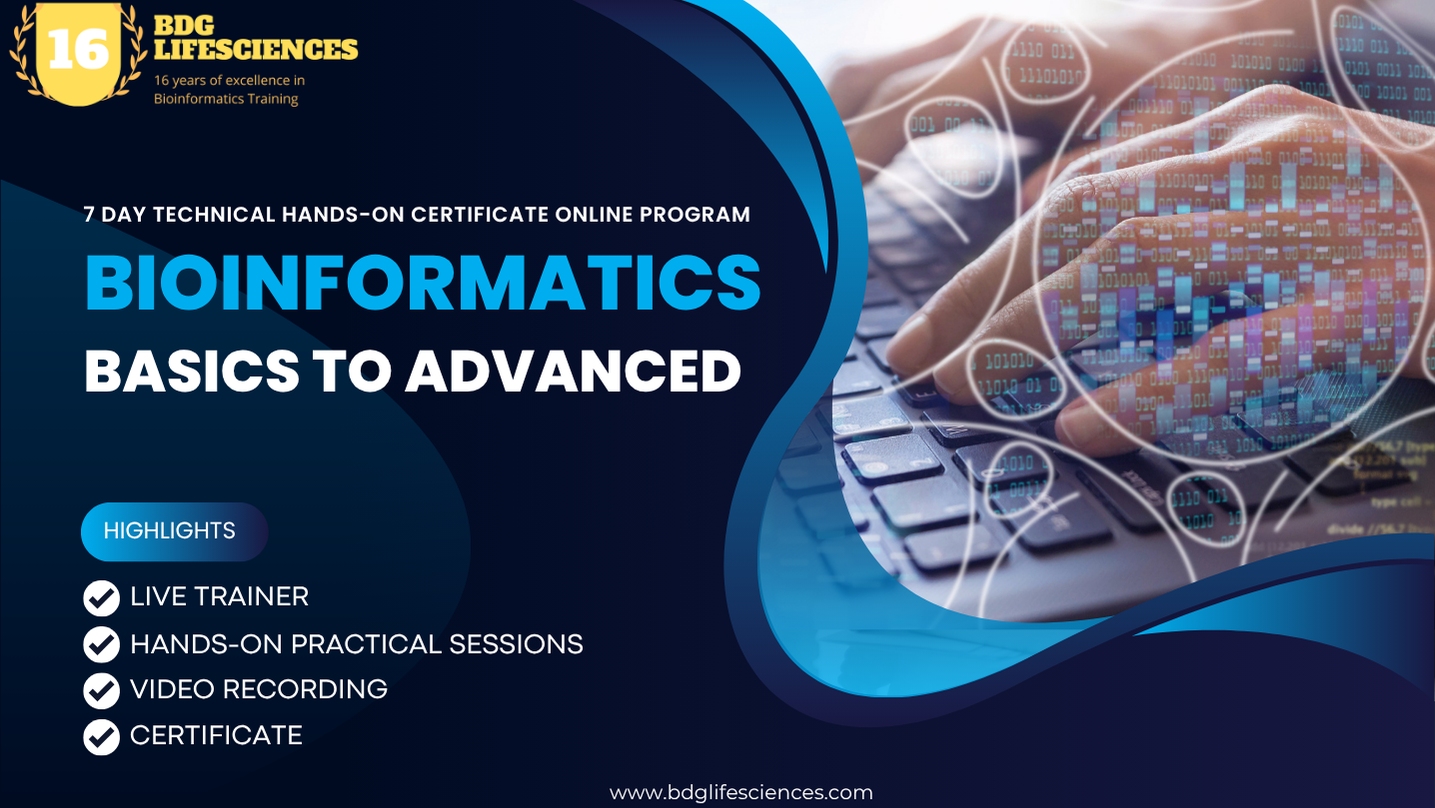
Bioinformatics | Basics to Advanced
7 Day Technical Hands-on Certificate Online Workshop in Bioinformatics | A Perfect Guide for Beginners from Basics to Advanced
4.7
This Event Includes
- High demand video
- Learn from Experts
- Hands-on practical sessions
- Certificate on completion
Registration Fee |
|
In US $ |
$ 79 |
In Indian Rupees |
₹ 7319 |
What is This Bioinformatics Workshop?
The 21st century has transformed biology into a data-driven science. Genomic sequences, protein structures, molecular interaction networks, and evolutionary relationships are no longer studied only at the laboratory bench — they are analysed computationally, using powerful databases, algorithms, and visualisation tools that every modern life scientist must know how to use.
Yet the vast majority of students, researchers, and professionals in biotechnology, pharmacy, genetics, and life sciences have never received formal, hands-on training in bioinformatics. They know the concepts exist. They have heard of BLAST, PyMOL, NCBI, and MEGA. But they have never sat down, opened these tools, and actually used them on real biological data — guided by an expert who can explain not just what to click, but why it matters.
BDG LifeSciences — established in 2010, MSME-registered under the Government of India, and globally authorised to operate in Australia and New Zealand via BBR Group Pty Ltd — has been delivering exactly this kind of practical, expert-led bioinformatics training for over 14 years. We are proud to present our 7-Day Technical Hands-On Certificate Online Workshop in Bioinformatics: A Perfect Guide for Beginners from Basics to Advanced.
Each of the 7 sessions runs for 2 hours live on Zoom with expert trainer Sharvari Kulkarni, CTO of BDG LifeSciences. Participants work on their own computers using real bioinformatics software and online tools — not watching slides, but actively running analyses on actual biological datasets. Session recordings are shared after every class. A Certificate of Completion with a unique verification barcode is awarded on successfully completing all tasks.
Whether you are a first-year undergraduate who has never opened NCBI, or a PhD researcher who wants to formalise and expand your computational skills, this program takes you from zero to confident bioinformatics practitioner in 7 structured days.
Workshop Dates
25 to 31 October, 2026. Live trainer- Online sessions from 7:30 AM - 9 AM India time +5:30 GMT/10 PM EDT/7 PM PDT (previous day).
7-Day Bioinformatics Workshop Curriculum — Day by Day Topics
A carefully designed 7-day program that progresses from bioinformatics fundamentals and database navigation, through sequence and structural analysis, all the way to genome browsing, phylogenetics, and advanced mutation analysis tools.
|
DAY 01 — Introduction to Bioinformatics & Databases
📌 Learning Outcome: Confidently navigate biological databases and extract protein physicochemical data for research use |
|
DAY 02 — Secondary Structure Prediction & Structural Alignment
📌 Learning Outcome: Predict protein secondary structures and perform structural superimposition for comparative analysis |
|
DAY 03 — Protein Interaction Networks & 3D Visualisation
📌 Learning Outcome: Build protein interaction networks and create publication-quality 3D protein visualisations |
|
DAY 04 — Sequence Alignment & Primer Design
📌 Learning Outcome: Perform BLAST searches confidently and design validated PCR primers for experimental use |
|
DAY 05 — Multiple Sequence Alignment & Phylogenetic Analysis
📌 Learning Outcome: Construct and interpret phylogenetic trees using two industry-standard platforms |
|
DAY 06 — Genome Browsing & Functional Prediction
📌 Learning Outcome: Navigate genome browsers, interpret genomic tracks, and predict protein function from sequence |
|
DAY 07 — Advanced Function Prediction, Mutation Analysis & Allosteric Signalling
📌 Learning Outcome: Predict protein structures from sequence, analyse mutation impact, and understand allosteric drug targeting |
Bioinformatics Tools & Databases Covered
|
NCBI Databases & Gene Map Viewer |
BLAST & Primer-BLAST Sequence alignment & primer design |
PyMOL & RasMol 3D protein visualisation |
MEGA X & Clustal Omega Phylogenetics & MSA |
|
SwissPdbViewer Structural superimposition |
UCSC Genome Browser Genome track navigation |
InterProScan Functional domain prediction |
Phyre2 & Allosigma Structure & mutation analysis |
Why You Should Attend This Bioinformatics Workshop
Bioinformatics is no longer a specialisation — it is a core competency demanded across every sector of modern life sciences. Here is exactly why this program will change the trajectory of your research and career:
|
Work on Real Tools from Day One This is not a lecture course. From Day 1, you work directly on your own laptop using the exact software and databases used in published research — NCBI, BLAST, PyMOL, MEGA X, UCSC Genome Browser, and more. You leave every session with a practical output, not just notes. |
Cover the Full Bioinformatics Pipeline in 7 Days Most bioinformatics courses focus on one tool or one technique. This workshop takes you through the complete pipeline — from database retrieval and sequence analysis, through structural visualisation and phylogenetics, to genome browsing and advanced mutation prediction. A full foundation in one program. |
|
Directly Strengthen Your Research & Publications Every tool covered in this workshop — PyMOL visualisations, BLAST alignments, phylogenetic trees, PPIN networks, functional domain maps — appears routinely in published research papers. After this workshop, you can generate these analyses and figures yourself for your thesis, dissertation, or journal submission. |
No Prior Bioinformatics Experience Required The workshop is explicitly designed as a guide from Basics to Advanced. Day 1 assumes you have never opened a bioinformatics tool before. By Day 7 you are performing allosteric signalling analysis and mutation impact prediction. The progression is structured, supported, and guided every step of the way by a live expert trainer. |
|
Build Career-Ready Skills in a Competitive Job Market Bioinformatics proficiency is now listed as a required or preferred skill in the majority of research, pharma, and biotech job postings globally. Completing this workshop and earning a verified certificate significantly strengthens your CV, LinkedIn profile, and competitiveness for positions in computational biology, genomics, drug discovery, and research roles. |
Understand COVID-19 & Pathogen Genomics Day 6 includes a dedicated case study on SARS-CoV-2 genome analysis using the UCSC Genome Browser — giving participants direct, practical experience with one of the most studied genomes in recent scientific history. This understanding is directly applicable to infectious disease research, public health, and genomics-based diagnostics. |
|
Globally Recognized Certificate with Barcode Earn a BDG LifeSciences Certificate of Completion carrying a unique verification barcode — recognized by academic institutions and employers across India, Australia, New Zealand, and internationally. Add it to your LinkedIn profile, university applications, or professional portfolio immediately. |
Session Recordings — Revisit Every Analysis Every session is recorded and shared with all participants after class via YouTube. Bioinformatics tools involve multi-step workflows that benefit from repetition — with recordings, you can pause, rewind, and re-run every analysis until it becomes second nature. |
Who Should Attend This Bioinformatics Workshop?
This workshop was built for everyone in life sciences who works with biological data — or who knows they should be, but has not yet received the training to do so confidently. No prior bioinformatics or coding experience is required.
|
Students B.Sc., M.Sc., Ph.D., MBBS, M.Pharm students in Biotechnology, Bioinformatics, Biochemistry, Microbiology, Genetics, Immunology, Pharmacy, Pharmaceutical Chemistry, Biomedical Technology, Plant Science, and Life Sciences |
Researchers & Faculty Research scholars, professors, and faculty members who want to incorporate bioinformatics tools into their research methodology, teach these techniques in their courses, or independently perform computational analyses for publications |
Industry Professionals Scientists, bioinformatics analysts, and professionals from biotechnology, pharmaceutical R&D, genomics, diagnostics, clinical research, and regulatory agencies who need practical bioinformatics competencies for their work |
|
Wet-Lab Scientists Experimental biologists and wet-lab researchers who want to complement their laboratory skills with computational analysis capabilities — designing better primers, understanding their protein targets structurally, and mining public databases for their research |
Drug Discovery Scientists Medicinal chemists, pharmacologists, and drug discovery researchers who want to understand target protein structure, identify allosteric binding sites, study mutation impacts on drug targets, and navigate genomic databases relevant to their therapeutic area |
Complete Beginners Anyone in life sciences who has always wanted to learn bioinformatics but did not know where to start. This workshop is explicitly titled "Basics to Advanced" because it starts from zero — no prior coding, no prior computational biology knowledge, and no specific software experience required |
Your Expert Trainer
Resource PersonSharvari KulkarniCTO, BDG LifeSciences | Bioinformatics & Computational Drug Design Expert Sharvari Kulkarni is one of India's most respected bioinformatics trainers and a leading expert in computational drug design, molecular simulations, molecular docking, and network pharmacology. As Chief Technology Officer of BDG LifeSciences, she leads the technical training division and has personally trained hundreds of participants globally — consistently receiving over 90% positive feedback for her structured, patient, and deeply practical teaching approach. Her expertise spans the full spectrum of computational biology tools — from bioinformatics databases and protein structure analysis through to MD simulations using GROMACS and Schrödinger's Desmond Maestro on both Windows and Linux platforms. She is the only trainer at BDG LifeSciences conducting hands-on MD simulation training specifically for protein-ligand complexes, providing participants with universal, reusable GROMACS analysis codes applicable to their own research. With over 15 research papers published in reputable peer-reviewed journals, Sharvari actively guides student research projects, serves on academic and industry panels, and speaks on international computational biology platforms. Her workshops are known for combining rigorous scientific content with accessible, step-by-step instruction — making complex bioinformatics tools genuinely learnable for participants at every level.
|
Why Choose BDG LifeSciences for Bioinformatics Training?
With 16+ years, 10000+ workshops, and participants trained across 40+ countries — here is what makes BDG LifeSciences the trusted choice for practical bioinformatics education.
|
16+ Years of Bioinformatics Training Excellence Since 2010, BDG LifeSciences has conducted workshops, training programs, and research projects in cutting-edge bioinformatics technologies — making us one of the most experienced and credible bioinformatics training providers in the world. We have refined this exact curriculum through multiple successful batches. |
Live Trainer — Real-Time Guidance on Every Tool Bioinformatics tools are best learned with an expert present to explain errors, demonstrate correct outputs, and answer questions in real time. Every session in this workshop is delivered live by Sharvari Kulkarni — not a pre-recorded video. You get immediate help when something does not work, and real-time explanations when results need interpretation. |
|
Real Data. Real Tools. Real Research Relevance. Every practical session uses real biological data — actual protein structures from PDB, real gene sequences from NCBI, the actual SARS-CoV-2 genome in UCSC. Participants do not work on simplified toy datasets. They work on the same data types used in published papers, building skills that are immediately transferable to their own research. |
Globally Trusted & Officially Registered MSME-registered under the Government of India (UDYAM-UP-01-0019151) and officially authorised to operate in Australia and New Zealand via BBR Group Pty Ltd (ACN 608 550 849). Our certificates carry a unique verification barcode and are recognized by academic institutions and employers across India, Australia, New Zealand, and internationally. |
|
Basics to Advanced in One Structured Program Most bioinformatics courses either start too advanced and lose beginners, or stay too basic and fail advanced participants. This program is explicitly designed to do both — starting from database navigation on Day 1 and reaching allosteric signalling analysis and mutation impact prediction on Day 7, with a logical, supported progression every step of the way. |
Verified Certificate for Your Academic & Professional Profile Every participant who successfully completes all tasks receives a BDG LifeSciences Certificate of Completion with a unique barcode — issued as a professional digital softcopy via email. Print it, add it to your LinkedIn, include it in university applications or job interviews. It is a concrete, verifiable credential that demonstrates real, tool-level bioinformatics proficiency. |
Registration Fee
Simple, Transparent Pricing
One fee for all participants. No hidden charges. Includes live sessions, session recordings, and completion certificate.
$ 79 US Dollars — same for all participants | Register Now →
Registration is non-refundable and non-transferable. Please read the full T&C below before registering.
Registration
How To Register
Secure your spot in 3 simple steps — seats are limited for each batch.
1️⃣ Click Register Now- Click the Register Now button and select number of tickets you want to buy..
2️⃣ Check Your Confirmation Email- After successful payment, check your email for a confirmation with registration details and next steps.
3️⃣ Receive Your Zoom Link- Once registration closes, you'll receive the Zoom meeting link and be added to the workshop WhatsApp group.
📧 Need help? Email us at workshops@bdglifesciences.com or chat with our AI Assistant George at bdglifesciences.com
Frequently Asked Questions — Bioinformatics Workshop
|
Q. What is this bioinformatics workshop about and who is it for? This is a 7-Day Technical Hands-On Certificate Online Workshop in Bioinformatics — a complete guide from Basics to Advanced, conducted live by expert trainer Sharvari Kulkarni, CTO of BDG LifeSciences. It covers biological databases, sequence analysis, structural bioinformatics, protein visualisation, phylogenetics, genome browsing, and advanced mutation and allosteric analysis. It is open to students, researchers, faculty, and industry professionals in any life sciences discipline. No prior bioinformatics experience is required. |
|
Q. Do I need prior coding or bioinformatics experience to attend? No. This workshop is specifically designed as a guide from Basics to Advanced — meaning it starts from the very beginning. Day 1 assumes you have never used a bioinformatics tool before. No coding, no programming, no prior computational biology knowledge is required. The trainer walks you through every step live, and recordings are shared after each session so you can revisit any analysis at your own pace. |
|
Q. What computer or software do I need for this workshop? You need a laptop or desktop computer (Windows, Mac, or Linux) with a stable internet connection. Most tools used in this workshop are web-based (NCBI, BLAST, Clustal Omega, InterProScan, STRING, Allosigma) and require no installation. PyMOL, RasMol, SwissPdbViewer, and MEGA X are free downloadable tools — the trainer guides installation on Day 1. No high-performance computing resources are required. |
|
Q. What is the registration fee and what is included? The registration fee is $79 USD for international participants and ₹7,319 Indian Rupees for participants in India. This flat fee includes all 7 live trainer sessions (1.5 hours each), session recordings shared after every class via YouTube, hands-on practical exercises each day, live Q&A and doubt resolution with the trainer after each session, and the BDG LifeSciences Certificate of Completion on successfully completing all tasks. There are no hidden charges. |
|
Q. Will I receive a certificate? How is it issued and verified? Yes. A BDG LifeSciences Certificate of Completion is awarded to every participant who successfully completes all tasks assigned by the trainer across the 7 days. The certificate is issued as a professional digital softcopy via email, carrying a unique barcode for independent online verification by employers and academic institutions. You may print it on heavy cardstock, laminate it, add it to your LinkedIn profile, or include it in job and university applications. The certificate will be issued exactly as per the name and details provided during registration. |
|
Q. Are sessions recorded? What if I miss a day? Yes — every session is recorded and shared with all registered participants after class each day, via YouTube using the Gmail ID you provide during registration. If you miss a session, you can still complete all assigned tasks by watching the recording at your own pace. Please register with the Gmail ID you actively use on YouTube to ensure immediate access. The program is fully self-paced for revision purposes. |
|
Q. What specific bioinformatics tools will I learn in this workshop? You will gain hands-on experience with: NCBI databases and Gene Map Viewer, ProtParam, TMHMM, Chou-Fasman secondary structure server, SwissPdbViewer for structural alignment, STRING for protein interaction networks, RasMol and PyMOL for 3D protein visualisation, BLAST and Primer-BLAST for sequence alignment and primer design, Clustal Omega and MEGA X for multiple sequence alignment and phylogenetics, UCSC Genome Browser, InterProScan for functional prediction, Phyre2 for structure and mutation analysis, and the Allosigma server for allosteric signalling analysis. |
|
Q. How will this bioinformatics workshop help my research and publications? Every tool covered in this workshop is routinely used in published research papers. After completing the workshop, you will be able to independently generate PyMOL protein visualisations, BLAST alignment figures, phylogenetic trees, protein interaction networks, functional domain maps, and allosteric site analyses — all of which are standard components of computational biology publications. This directly strengthens the quality of your thesis, dissertation, and journal submissions. |
|
Q. What platform will live sessions be conducted on? Live sessions are conducted on Zoom or Google Meet from 7:30 AM to 9 AM India time (IST, GMT +5:30). The Zoom meeting link will be sent to all registered participants after the registration period closes. You will need a stable internet connection and the Gmail ID used during registration to access session recordings on YouTube. |
|
Q. How is this bioinformatics workshop different from a YouTube tutorial or free online course? Unlike YouTube tutorials or free courses, this workshop provides a live expert trainer who can answer your specific questions, troubleshoot errors on your individual system in real time, and guide you through multi-step analyses where each step depends on the previous. You also receive structured, progressive content across 7 days — not isolated, disconnected videos. Additionally, you earn a verified, barcoded BDG LifeSciences Certificate of Completion that no free online tutorial can provide. |
|
Q. Is the registration fee refundable or transferable? No. The registration fee is non-refundable and non-transferable. Please read the full Terms & Conditions carefully before completing registration, and ensure you register under the correct participant category (India or Outside India). Registering under the wrong category will result in cancellation with no refund. BDG LifeSciences reserves the right of admission to all its programs. |
T & C
- For this event the Fee is same for all participants which is $ 79 US equivalent to 7319 Indian Rupees.
- Please provide a GMAIL ID for registration as the recorded video session will be provided on YouTube. Kindly provide that email ID by which you use YouTube.
- Video recording of each session will be provided at the end of the session to give the user a unique learning experience.
- Interactive training sessions will be conducted on Google Meet/Zoom so to give users a better learning experience.
- As it is with a LIVE TRAINER hence practical application, i.e., the experiments/tasks to be performed can be done in the best explainable manner.
- In this Online Workshop, there will be a LIVE trainer who will solve queries along with training.
- The program is SELF-PACED. After each session video of that particular session will be shared with you so you can go through as many times as you want and perfect yourself in the topics & tasks.
- If you miss any session then NO PROBLEM you can still perform the tasks by going through the video of that particular session.
- Make sure you register under the right category. If you register under the wrong category then your registration will be invalid and NO REFUND WILL BE MADE IN THIS CASE. This is your mistake and the company is not responsible for it.
- To avoid this do read the description of the ticket before selecting and proceeding with payment.
- You need to upload your professional ID which can be your Student ID Card or Research Institute ID Card or Company ID Card. DO NOT UPLOAD EXPIRED ID OR ANY GOVERNMENT ID LIKE AADHAR, PAN, you have to upload professional ID.
- If you are currently not employed or not studying, you may upload the professional ID from your previous affiliation (degree or company), provided you are registering under the correct category. If you are in India, or will be in India at the time of the workshop or training or research project, your category will be Participants in India, and you can upload any valid ID (including one from your previous affiliation). If, at the time of the workshop or training or research project, you are not in India, your category will be Participants outside India, and you can upload any valid ID.
- After registration, you will join the workshop's WhatsApp group. If you have registered in the "Participants in India" category, you must join using an Indian phone number only.
- The certificate will be issued as per the details which you provide in the registration form while registering before payment.
- Once you register relax we will send you the meeting link after the workshop registration gets over.
- We want to make sure that you learn properly hence the training certificate will be given ONLY on successful completion of all the tasks given by the trainer.
- The certificates of all our Online programs are sent by email(softcopy) which has a unique barcode. You can take a print of that on heavy cardstock or photo paper and get it laminated if required.
- The registration is NON-REFUNDABLE and NON-TRANSFERABLE.
- BDG Lifesciences reserves the right of admission in all our programs.
- If you are removed or your registration is canceled then there will be no answer to that. We have our own reasons for such an act of ours
- If we do not wish to give this workshop to any participant then we will refund their amount.
- You should also read the Terms & Conditions page as well as the FAQs page. For any assistance kindly chat with our AI Assistant George on the website www.bdglifesciences.com.
BDG LifeSciences
BDG LifeSciences is a distinguished bioinformatics company established in 2010 and operates globally. Headquartered in India, the company specializes in facilitating workshops, training programs, novel and innovative research projects, and online courses in bioinformatics and life sciences. BDG LifeSciences is registered under the Ministry of MSME (Micro, Small, and Medium Enterprises), Government of India, with the registration number UDYAM-UP-01-0019151. In January 2024, BDG LifeSciences, India, has authorized BBR Group Pty Ltd., Australia (ACN 608 550 849), to operate its programs in Australia and New Zealand.
With a strong focus on the practical application of technology, BDG LifeSciences provides hands-on training where participants work on their own computers/laptops using specialized software and servers. The company has been a leader in this sector for the last 16 years, successfully educating a diverse range of participants, including students, scientists, faculty members, professors, and corporate executives worldwide.
Programs
Related Workshops
- Bioinformatics Workshop
- Drug Discovery & Design
- WGS Analysis Workshop
- NGS Healthcare Workshop
- Transcriptomics Workshop
Company
- About Us
- Publications
- Advisors & Collaborators
- Blogs
- Careers
- FAQs
- Terms & Conditions
- Privacy Policy
- Contact Us
© 2026 BDG Lifesciences. All Rights Reserved. | 16+ Years of Bioinformatics Excellence | Trusted by 50,000+ Participants in 40+ Countries Privacy Policy · Terms & Conditions
Recommended Just for You