More
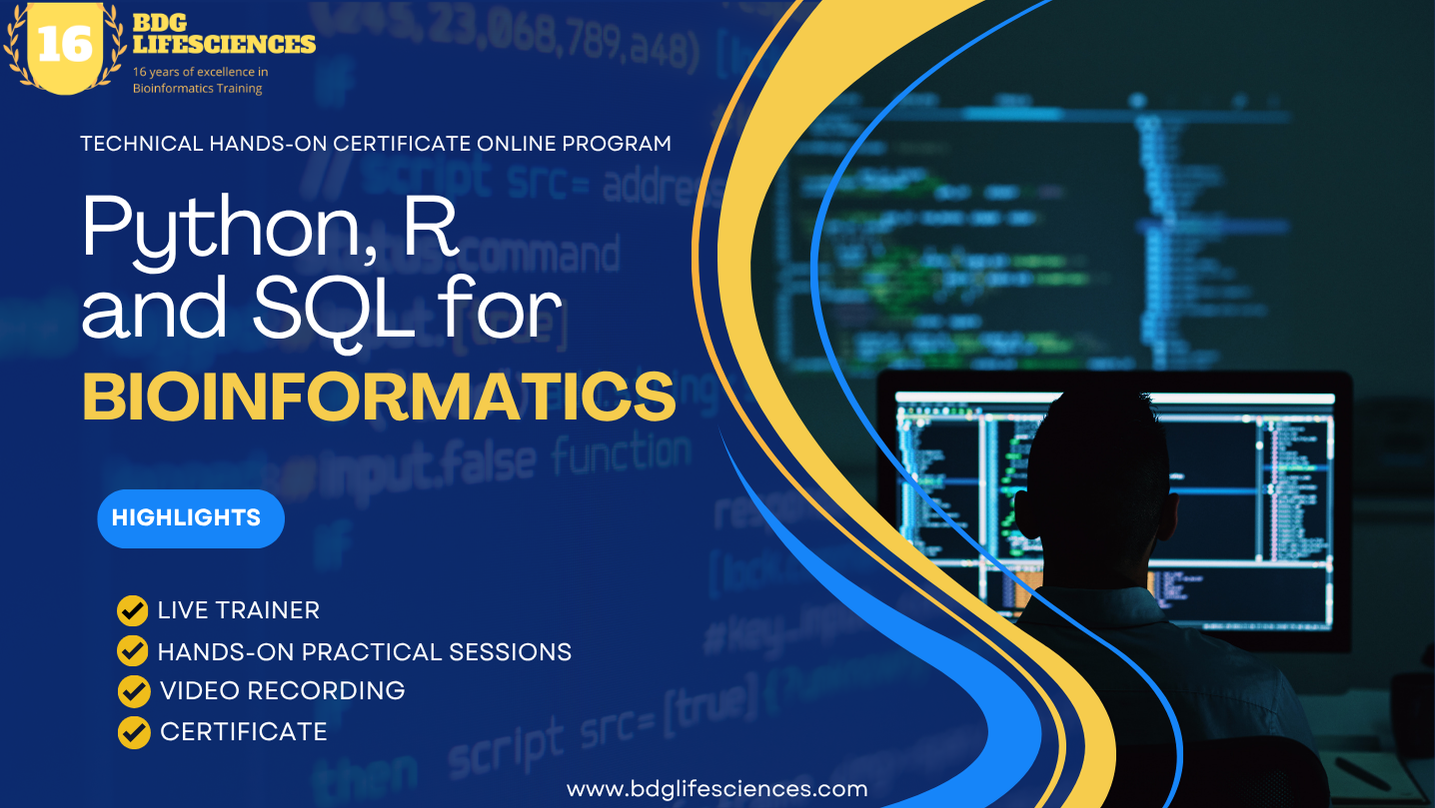
Python, R and SQL for Bioinformatics – 7-Day Online Workshop
Learn to integrate Python programming, R statistical analysis and SQL database querying into a reproducible bioinformatics workflow.
4.7
This Event Includes
- High demand video
- Learn from Experts
- Hands-on practical sessions
- Certificate on completion
Registration Fee |
|
In US $ |
$ 93 |
In Indian Rupees |
₹ 8830 |
7-Day Python, R and SQL for Bioinformatics Workshop
One connected workflow. One shared gene-expression and clinical dataset. Three languages that work together.
Python |
R |
SQL |
7Daily sessions |
90 minPer session |
3Languages |
US$93Registration fee |
Introduction
Bioinformatics research increasingly requires the ability to work with biological datasets, organise experimental information, perform statistical analysis, and generate reproducible results. While Python and R are widely used for biological data analysis, SQL provides an important way to organise, retrieve, and manage the sample and clinical metadata associated with research datasets.
The 7-Day Python, R and SQL for Bioinformatics Workshop by BDG Lifesciences is designed to introduce participants to the practical use of these three technologies within a connected bioinformatics workflow.
The programme covers Python programming for biological tables and sequences, R for statistical analysis and data visualisation, and SQL for querying sample metadata. Participants will also explore project organisation, environment management, version control, and reproducible research practices.
Rather than treating Python, R and SQL as isolated subjects, the workshop connects them through a shared public gene-expression and clinical dataset. This provides an opportunity to understand how different tools can contribute to different stages of a bioinformatics project.
| Across seven sessions, participants will work towards: a reusable project structure, a functional Python notebook, data-wrangling workflows, statistical visualisations, and a small report generated from code. |
Overview
The workshop introduces three complementary technologies used in computational biology and bioinformatics: Python, R and SQL. The seven-day programme follows a practical progression, beginning with project organisation and reproducible computing before moving into biological data handling, statistical analysis, database queries, and an integrated workflow.
Share of Curriculum Topics
 |
|
||||||||||||||||||||
Topics Covered per Component
| Project Setup |
|
6 | |
| Python |
|
6 | |
| R |
|
7 | |
| SQL |
|
6 | |
| Integration |
|
6 |
The Five Components
| Project Setup and Reproducible Work Participants will explore how to organise a bioinformatics project using a structured directory containing separate folders for data, scripts and figures. Topics include:
|
Python for Tables and Biological Sequences Python programming for biological data handling and basic sequence-related tasks. Topics include:
|
|||||||||||||||||||||||||||
| R for Statistics and Data Visualisation Participants will explore R as a statistical computing and visualisation environment for bioinformatics research. Topics include:
|
SQL for Biological Sample Metadata This component introduces relational databases and SQL queries for retrieving and organising sample-related information. Topics include:
|
|||||||||||||||||||||||||||
| Integrating Python, R and SQL The final component connects the three technologies within a common bioinformatics workflow. Participants will explore: Topics include:
|
||||||||||||||||||||||||||||
Methodology
The workshop follows a practical, application-oriented teaching approach, with seven sessions of 90 minutes each. Instead of learning Python, R and SQL as disconnected programming subjects, participants will explore how these technologies can be applied together in a bioinformatics project. The learning approach combines programming concepts, demonstrations, data manipulation, statistical analysis, database querying and reproducible reporting.
1 |
Step 1: Establishing a Reproducible Project Environment Participants will learn how to structure a bioinformatics project and organise data, scripts and figures. The sessions introduce Python environment management, the concept of renv in R, and basic Git operations for tracking project changes. |
|
2 |
Step 2: Working with Biological Data Using Python The Python component introduces essential programming concepts and their application to biological tables and sequences. Participants will explore pandas for reading, filtering, merging and grouping data, along with visualisation using Matplotlib or Seaborn. Basic FASTA sequence handling will be introduced using Biopython. |
|
3 |
Step 3: Statistical Analysis and Visualisation Using R The R component focuses on data manipulation using Tidyverse and graphical representation using ggplot2. Participants will also be introduced to the concept of differential expression analysis through one pipeline using either limma or edgeR. |
|
4 |
Step 4: Retrieving Biological Metadata Using SQL Participants will explore relational database concepts and write SQL queries to retrieve and summarise sample information. SQLite will be used as a project-level database, with database connectivity introduced through Python sqlite3 or R DBI. |
|
5 |
Step 5: Connecting the Three Technologies The final learning component brings Python, R and SQL together using the same public gene-expression and clinical dataset. Participants will examine which tool is appropriate for different stages of data handling and analysis and organise their work into a reusable project with a short README. |
|
The workshop is designed around a laptop-based working environment. The programme does not specify a requirement for dedicated servers.
Target Audience for This Program
The workshop is relevant to individuals interested in developing practical programming and data-handling skills for bioinformatics and computational biology. It is particularly suitable for:
| Undergraduate Students Students in biotechnology, bioinformatics, life sciences, microbiology, biochemistry, genetics and related disciplines who want an introduction to computational tools used in biological research. |
Postgraduate Students MSc and MTech students looking to improve their ability to organise, process and analyse biological datasets. |
PhD Scholars and Research Scholars Researchers interested in using Python, R and SQL for biological data manipulation, statistical analysis and sample metadata management. |
||
| Bioinformatics Students Learners who want to understand how programming languages and database technologies can work together in a research workflow. |
Life Sciences Researchers Academics and research professionals who regularly work with gene-expression datasets, clinical tables or other biological information. |
Computational Biology Enthusiasts Individuals interested in building a foundation in reproducible computational research. |
||
Participants with an interest in biological data analysis will find the programme relevant. Formal prerequisites or a minimum programming experience level have not been specified.
Why You Should Attend
Bioinformatics projects frequently involve more than one programming language or analytical tool. Researchers may use Python to process biological data, R to perform statistical analysis and generate figures, and SQL to retrieve specific sample information from structured datasets.
Understanding how these tools complement one another can make research workflows more organised and reproducible. This workshop brings these elements together through several connected learning areas.
| Learn three complementary technologies within one research workflow Explore Python, R and SQL in the context of biological data rather than studying each technology independently. |
Work with biological tables and sequences Use pandas for tabular data manipulation and Biopython for basic FASTA sequence handling. |
|
| Understand statistical analysis in R Explore Tidyverse, ggplot2 and the basic concept of differential expression analysis through one limma or edgeR pipeline. |
Move beyond spreadsheets for metadata management Learn how SQL queries can retrieve and summarise sample information using a structured SQLite database. |
|
| Develop better research organisation practices Understand project folder structures, environment management and basic Git version control to support reproducible computational work. |
Connect the tools using a common dataset Explore how Python, R and SQL can contribute to different stages of a bioinformatics project using the same public gene-expression and clinical dataset. |
|
What Are the Benefits of This Program?
By completing the programme, participants can develop an introductory practical understanding of how programming, data management and statistical analysis fit into a bioinformatics workflow. The expected learning outcomes include:
| Organised Bioinformatics Projects Understand how to create a clean project structure with separate directories for data, scripts and figures. |
Python-Based Data Handling Practise working with biological tables using pandas, including reading, filtering, merging and grouping datasets. |
Basic Biological Sequence Processing Explore FASTA sequence handling using Biopython. |
||
| Statistical Data Analysis with R Understand the use of Tidyverse packages for data manipulation and ggplot2 for statistical visualisation. |
Introduction to Differential Expression Analysis Understand the basic idea behind differential expression analysis and explore one pipeline using either limma or edgeR. |
Database Querying Skills Understand relational tables, keys and SQL queries, including SELECT, WHERE, JOIN and GROUP BY. |
||
| Reproducible Reporting Explore how R Markdown or Quarto can be used to generate reports from analytical code. |
Integrated Computational Workflow Understand how Python, R and SQLite can work together within a single project. |
Reusable Research Materials Work towards a small reusable project package containing a structured project skeleton, a working notebook, analytical outputs and a short README. |
||
The emphasis is on developing practical familiarity with the tools and understanding their application. The extent of independent proficiency will depend on participants’ prior experience and continued practice.
How It Will Help You in Your Career
Programming and data management are increasingly relevant to research activities across bioinformatics, computational biology, genomics and biomedical sciences. An understanding of Python, R and SQL can provide a useful foundation for individuals planning to work with biological datasets or pursue computational research.
| For postgraduate and PhD research: Knowledge of Python and R can support biological data processing, statistical analysis and the preparation of figures and reports for research projects. |
|
| For gene-expression research: Familiarity with Tidyverse, ggplot2 and an introductory limma or edgeR pipeline can help participants understand the computational steps involved in analysing gene-expression data. |
|
| For clinical and biological data management: SQL and SQLite provide an introduction to querying structured sample and clinical metadata rather than relying exclusively on manual spreadsheet searches. |
|
| For computational biology projects: Understanding how Python, R and SQL complement one another can help participants organise analytical tasks and select appropriate tools for different stages of a project. |
|
| For reproducible research: Project organisation, environment management, Git and code-generated reporting introduce practices that can support better documentation and reproducibility. |
|
These skills may be useful when progressing towards research projects, postgraduate studies or entry-level computational biology activities. However, this seven-day introductory programme is not a substitute for advanced programming training or specialised bioinformatics analysis experience.
Why Choose BDG Lifesciences for This Program?
| Established in 2010, BDG Lifesciences is a bioinformatics training and contract research organisation focused on computational life sciences and scientific research. Its training programmes cover a range of bioinformatics and computational biology subjects, serving students, researchers and professionals across multiple countries. |
The Python, R and SQL for Bioinformatics workshop reflects the practical requirements of computational research: handling biological data, organising analytical projects, performing statistical analysis and retrieving structured metadata. The programme brings these areas together through a connected learning approach rather than treating programming languages as unrelated subjects.
With its background in bioinformatics education and scientific training, BDG Lifesciences aims to make computational concepts accessible through subject-focused learning and practical research applications. For participants looking to develop a foundation in programming for bioinformatics, this workshop offers an opportunity to explore three complementary technologies within a single programme.
Registration Fee
Simple, Transparent Pricing
One fee for all participants. No hidden charges. Includes live sessions, session recordings, and completion certificate.
| $ 93 US Dollars — For all participants across the world | Click here to Register |
Registration is non-refundable and non-transferable. Please read the full T&C below before registering.
Frequently Asked Questions (FAQs)
| 1. What is the Python, R and SQL for Bioinformatics workshop about? This is a seven-day training programme covering the application of Python, R and SQL to bioinformatics projects. It introduces Python for biological tables and sequences, R for statistics and visualisation, and SQL for querying sample and clinical metadata. |
|
| 2. How long is the workshop? The workshop runs for seven days, with each session lasting 90 minutes. |
|
| 3. What programming languages will be covered? The programme covers Python, R and SQL. Participants will explore how these technologies complement one another in biological data processing, statistical analysis and metadata management. |
|
| 4. Will I learn Python specifically for bioinformatics? Yes. The Python component covers variables, lists and functions, along with pandas for reading, filtering, merging and grouping tabular data. Participants will also explore data visualisation using Matplotlib or Seaborn and basic FASTA sequence handling using Biopython. |
|
| 5. What will I learn in the R component? The R component covers data manipulation using Tidyverse packages, including dplyr, readr and tidyr. It also introduces ggplot2 for visualisation, the basic concept of differential expression analysis using one limma or edgeR pipeline, and reproducible reporting using R Markdown or Quarto. |
|
| 6. Why is SQL important in bioinformatics? Bioinformatics projects often involve sample information, experimental details and clinical metadata stored in structured tables. SQL helps retrieve and organise this information using queries such as SELECT, WHERE, JOIN and GROUP BY. The workshop introduces these concepts using SQLite. |
|
| 7. Will I learn Python, R and SQL using the same dataset? Yes. The integration component uses the same public gene-expression and clinical dataset to explore how Python, R and SQL can contribute to different stages of a bioinformatics workflow. |
|
| 8. Which software and tools will be used? The programme covers VS Code or RStudio, Miniconda or Python virtual environments, Python 3, JupyterLab, pandas, NumPy, Matplotlib, Seaborn, Biopython, R, Tidyverse, ggplot2, and either limma or edgeR. SQLite will be explored using DB Browser for SQLite or DBeaver, alongside Python sqlite3 or R DBI. |
|
| 9. Will I learn Git and reproducible research practices? Yes. The workshop introduces project folder organisation, environment management using Conda or venv, the concept of renv in R, and basic Git operations including add, commit and .gitignore. |
|
| 10. What will I be able to develop after the workshop? The intended learning outcomes include a clean reusable project structure, a working Python notebook, table-wrangling and a simple sequence task, figures and a small code-generated report, and a reusable project package using at least two of the three technologies. |
|
| 11. Who can register for this workshop? The programme is relevant to undergraduate and postgraduate students, PhD scholars, bioinformatics learners, life sciences researchers and professionals interested in computational biology. Specific programming prerequisites have not been stipulated. |
|
| 12. What is the registration fee? The registration fee is US$93 for the seven-day programme, comprising seven sessions of 90 minutes each. |
|
Ready to connect Python, R and SQL?Seven sessions of 90 minutes · Registration fee: US$93 |
Registration
How To Register
Secure your spot in 3 simple steps — seats are limited for each batch.
1️⃣ Click Register Now- Click the Register Now button and select number of tickets you want to buy..
2️⃣ Check Your Confirmation Email- After successful payment, check your email for a confirmation with registration details and next steps.
3️⃣ Receive Your Zoom Link- Once registration closes, you'll receive the Zoom meeting link and be added to the workshop WhatsApp group.
📧 Need help? Email us at workshops@bdglifesciences.com or chat with our AI Assistant George at bdglifesciences.com
T & C
- For this event the Fee is same for all participants which is $ 93 US equivalent to 8830 Indian Rupees.
- Please provide a GMAIL ID for registration as the recorded video session will be provided on YouTube. Kindly provide that email ID by which you use YouTube.
- Video recording of each session will be provided at the end of the session to give the user a unique learning experience.
- Interactive training sessions will be conducted on Google Meet/Zoom so to give users a better learning experience.
- As it is with a LIVE TRAINER hence practical application, i.e., the experiments/tasks to be performed can be done in the best explainable manner.
- In this Online Workshop, there will be a LIVE trainer who will solve queries along with training.
- The program is SELF-PACED. After each session video of that particular session will be shared with you so you can go through as many times as you want and perfect yourself in the topics & tasks.
- If you miss any session then NO PROBLEM you can still perform the tasks by going through the video of that particular session.
- Make sure you register under the right category. If you register under the wrong category then your registration will be invalid and NO REFUND WILL BE MADE IN THIS CASE. This is your mistake and the company is not responsible for it.
- To avoid this do read the description of the ticket before selecting and proceeding with payment.
- You need to upload your professional ID which can be your Student ID Card or Research Institute ID Card or Company ID Card. DO NOT UPLOAD EXPIRED ID OR ANY GOVERNMENT ID LIKE AADHAR, PAN, you have to upload professional ID.
- If you are currently not employed or not studying, you may upload the professional ID from your previous affiliation (degree or company), provided you are registering under the correct category. If you are in India, or will be in India at the time of the workshop or training or research project, your category will be Participants in India, and you can upload any valid ID (including one from your previous affiliation). If, at the time of the workshop or training or research project, you are not in India, your category will be Participants outside India, and you can upload any valid ID.
- After registration, you will join the workshop's WhatsApp group. If you have registered in the "Participants in India" category, you must join using an Indian phone number only.
- The certificate will be issued as per the details which you provide in the registration form while registering before payment.
- Once you register relax we will send you the meeting link after the workshop registration gets over.
- We want to make sure that you learn properly hence the training certificate will be given ONLY on successful completion of all the tasks given by the trainer.
- The certificates of all our Online programs are sent by email(softcopy) which has a unique barcode. You can take a print of that on heavy cardstock or photo paper and get it laminated if required.
- The registration is NON-REFUNDABLE and NON-TRANSFERABLE.
- BDG Lifesciences reserves the right of admission in all our programs.
- If you are removed or your registration is canceled then there will be no answer to that. We have our own reasons for such an act of ours
- If we do not wish to give this workshop to any participant then we will refund their amount.
- You should also read the Terms & Conditions page as well as the FAQs page. For any assistance kindly chat with our AI Assistant George on the website www.bdglifesciences.com.
BDG LifeSciences
BDG LifeSciences is a distinguished bioinformatics company established in 2010 and operates globally. Headquartered in India, the company specializes in facilitating workshops, training programs, novel and innovative research projects, and online courses in bioinformatics and life sciences. BDG LifeSciences is registered under the Ministry of MSME (Micro, Small, and Medium Enterprises), Government of India, with the registration number UDYAM-UP-01-0019151. In January 2024, BDG LifeSciences, India, has authorized BBR Group Pty Ltd., Australia (ACN 608 550 849), to operate its programs in Australia and New Zealand.
With a strong focus on the practical application of technology, BDG LifeSciences provides hands-on training where participants work on their own computers/laptops using specialized software and servers. The company has been a leader in this sector for the last 16 years, successfully educating a diverse range of participants, including students, scientists, faculty members, professors, and corporate executives worldwide.
Programs
Related Workshops
- Bioinformatics Workshop
- Drug Discovery & Design
- Molecular Docking Workshop
- MD Simulations Workshop
- WGS Analysis Workshop
- NGS Healthcare Workshop
- Transcriptomics Workshop
Company
- About Us
- Publications
- Advisors & Collaborators
- Blogs
- Careers
- FAQs
- Terms & Conditions
- Privacy Policy
- Contact Us
© 2026 BDG Lifesciences. All Rights Reserved. | 16+ Years of Bioinformatics Excellence | Trusted by 2,000+ Participants in 40+ Countries Privacy Policy · Terms & Conditions
Recommended Just for You